Jun 24, 2026
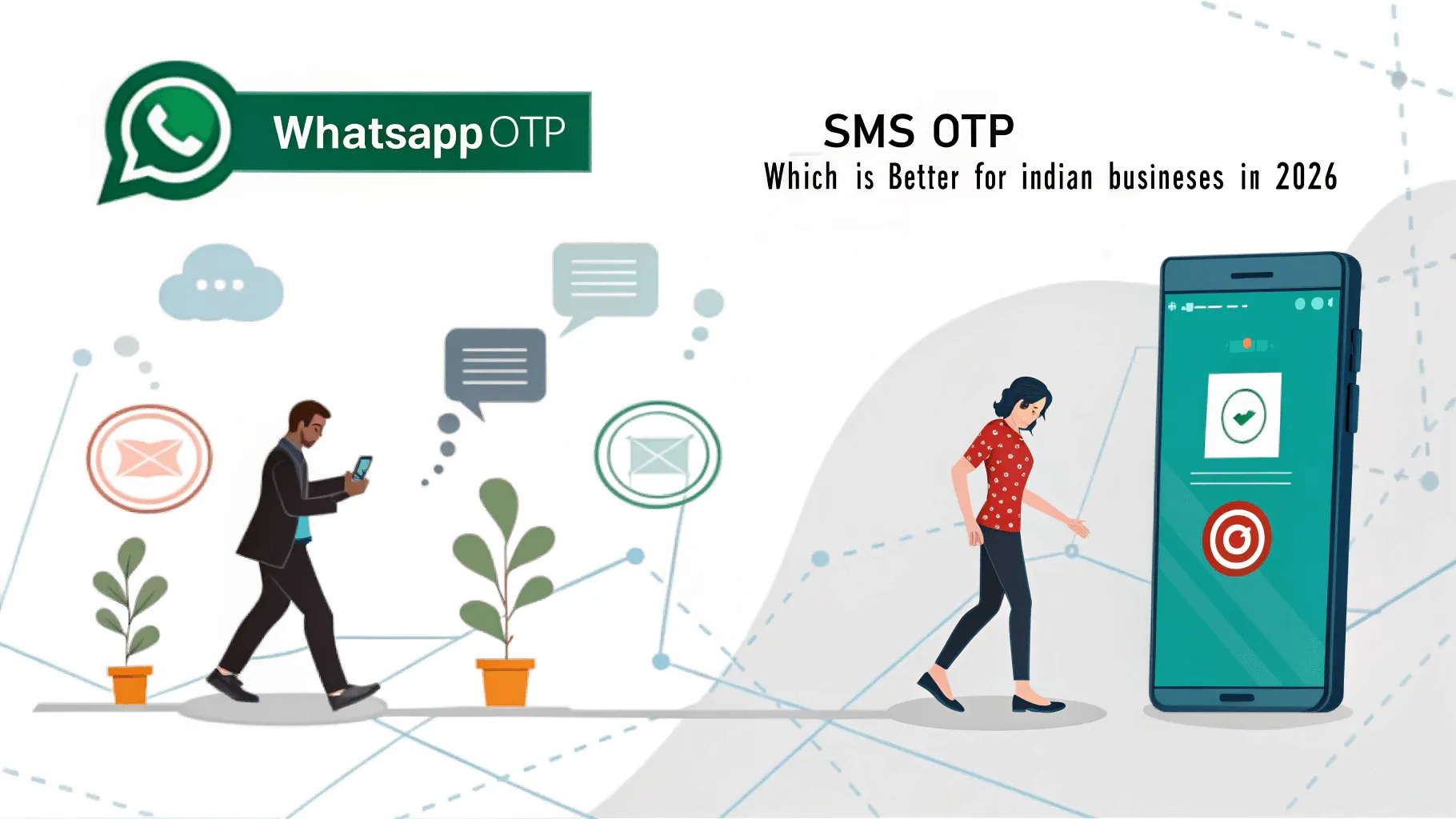
Confused between WhatsApp OTP and SMS OTP for your Indian business? Compare delivery rates, security, cost, and DLT compliance in this complete 2026 guide.
OTP verification is the backbone of India's digital economy. From UPI payments and banking logins to eCommerce
checkouts and SaaS sign-ups, every business that handles user authentication
relies on OTPs. But the channel you choose to deliver those OTPs — WhatsApp or
SMS — can directly impact your delivery rates, security, compliance cost, and
ultimately your conversion rates.
In
India's complex telecom landscape — where DLT regulations, SIM swap fraud, and
patchy rural connectivity are real challenges — choosing the wrong OTP channel
can cost you thousands of failed transactions every month. This guide gives you
a complete, data-driven comparison of WhatsApp OTP vs SMS OTP so you can make
the right decision for your business in 2026.
|
98% WhatsApp open rate |
99.5% WhatsApp OTP delivery |
67% Users abandon if OTP > 30s |
500M+ WhatsApp users in India |
What Is SMS OTP? (And How It Works in India)
SMS
OTP (One-Time Password via SMS) is the traditional method of sending a unique,
time-limited code to a user's mobile number via telecom carrier networks. It
does not require internet connectivity, which makes it universally accessible
across all mobile phones in India, including 2G feature phones.
How
SMS OTP works in India:
1. User enters their mobile number and requests
verification
2. Your system generates a unique OTP and sends it via an
SMS gateway
3. The SMS gateway routes the message through India's DLT
(Distributed Ledger Technology) system — mandatory since 2019
4. The telecom operator delivers the SMS to the user's
phone
5. User enters the code within the validity window
(typically 3–10 minutes)
|
⚠️ |
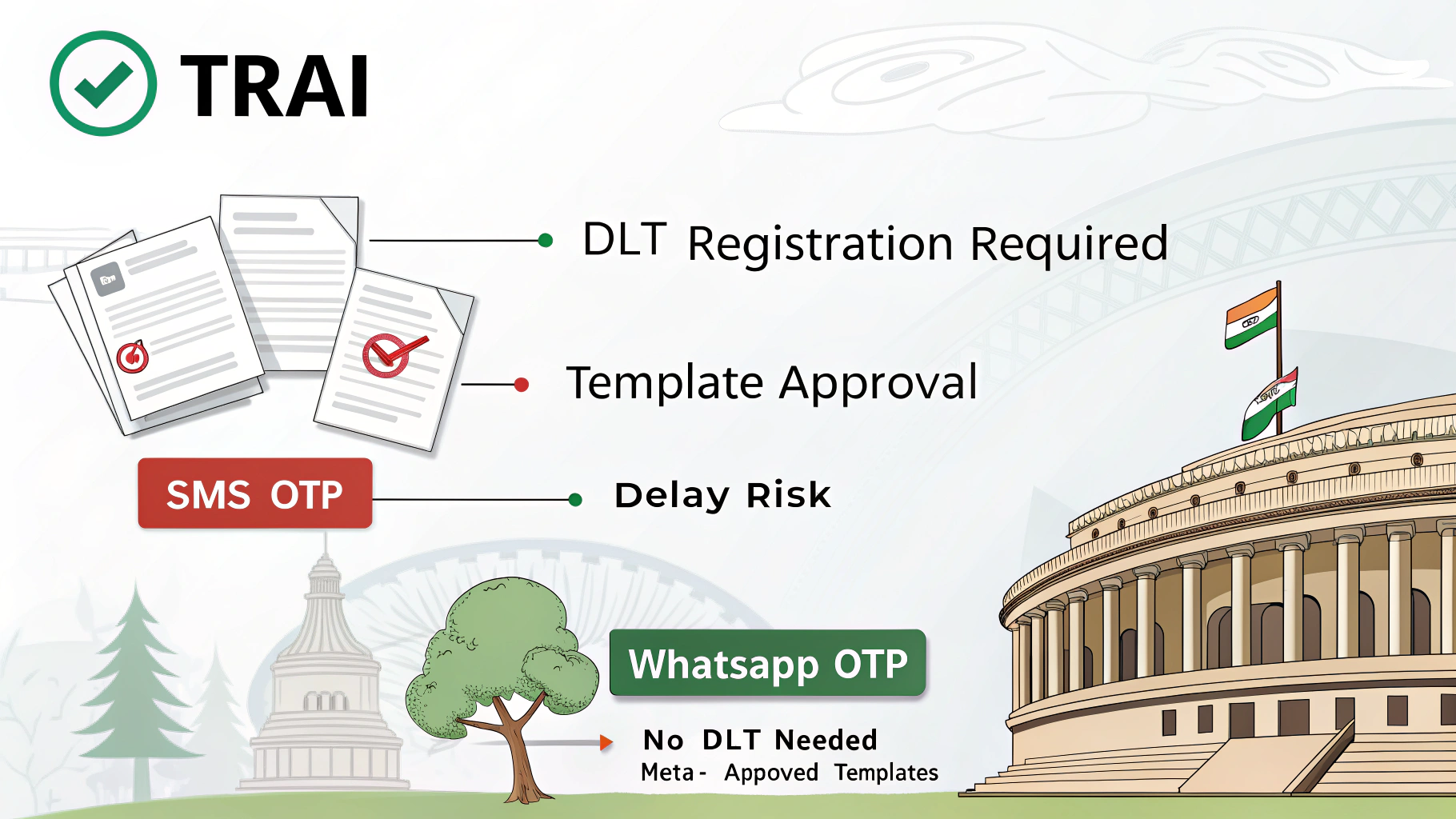
India's TRAI DLT regulations require every business SMS —
including OTP messages — to register sender headers and message templates
before sending. Non-compliant templates are automatically blocked by telecom
operators, causing OTP delivery failures. |
What Is WhatsApp OTP? (And How It Works)
WhatsApp
OTP is an authentication message sent through WhatsApp's Business API instead
of the traditional SMS network. It uses the internet to deliver a one-time
password directly into a user's WhatsApp inbox — with the sender verified as
your official business account.
How
WhatsApp OTP works:
6. User enters their WhatsApp-registered mobile number
7. Your system triggers the OTP via WhatsApp Business API
using an approved Authentication template
8. WhatsApp delivers the code to the user's inbox within
2–4 seconds
9. User sees your verified business name, not an unknown
number
10.User copies or auto-fills the code (Android supports native OTP auto-fill)
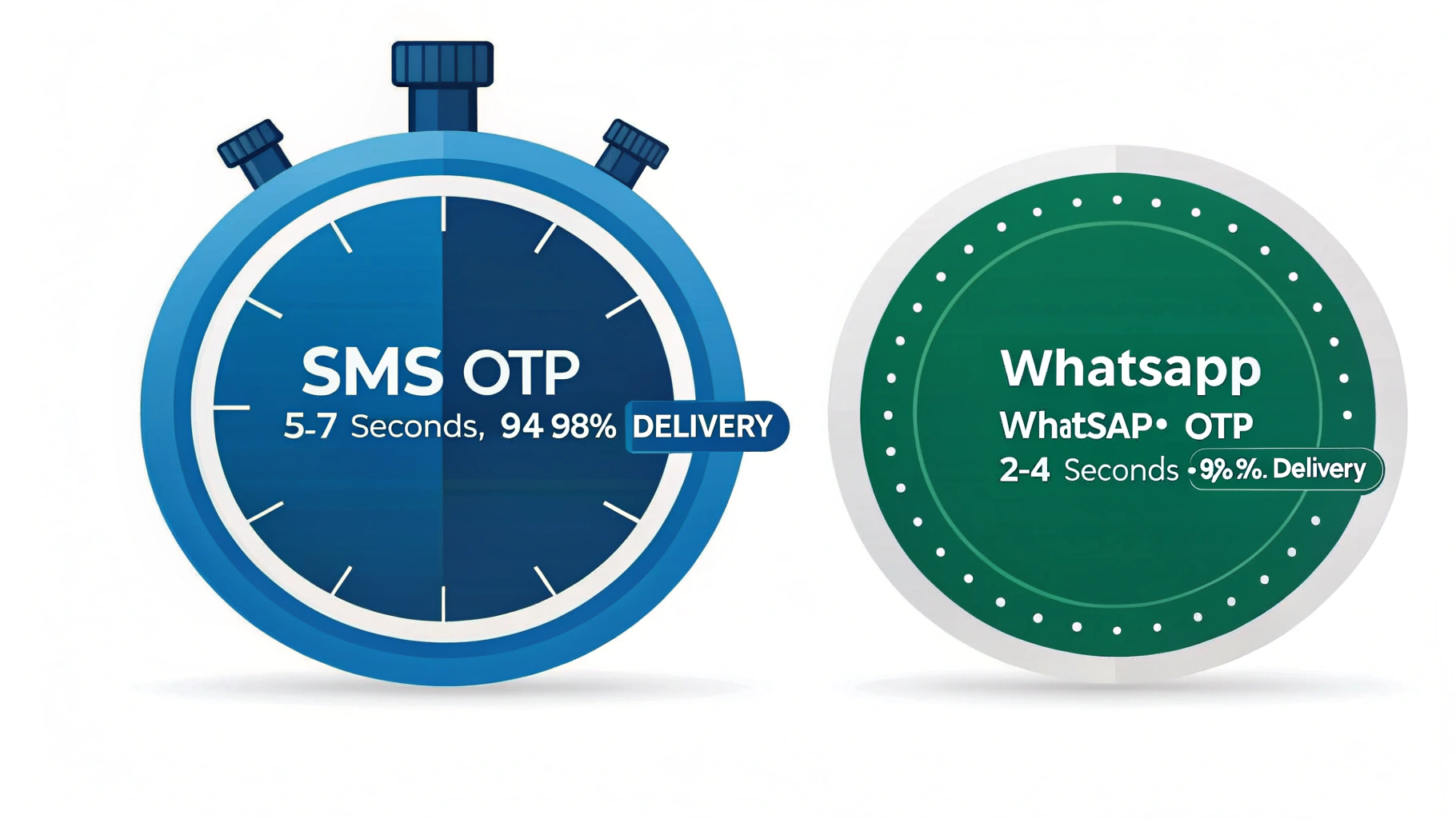
WhatsApp OTP vs SMS OTP — Full Comparison Table (2026)
Here
is a side-by-side breakdown of every factor that matters for Indian businesses:
|
Feature |
📱 WhatsApp OTP |
💬 SMS OTP |
|
Delivery
Speed |
2–4 seconds
avg |
5–7 seconds
avg |
|
Delivery
Success Rate |
99.5%+ with
API |
94–98%
post-DLT compliance |
|
Requires
Internet |
Yes — data
connection needed |
No — works on
any network |
|
Encryption |
End-to-end
encrypted (Meta) |
No encryption
— plain text |
|
DLT
Registration (India) |
Not required |
Mandatory
(TRAI compliance) |
|
Sender
Identity |
Verified
business name + logo |
Numeric
sender ID or header |
|
Security
Risk |
Low —
encrypted + verified |
SIM swap
& interception risk |
|
Open Rate |
98% (WhatsApp
inbox) |
~70–75% (SMS
spam filters) |
|
Cost per
OTP (India) |
₹0.30–0.40
(Auth template) |
₹0.15–0.30
per SMS |
|
Interactive
Features |
Buttons,
auto-fill, rich media |
Plain text
only |
|
Works on
Feature Phones |
No —
smartphone + WhatsApp needed |
Yes — all
mobile phones |
|
Brand
Trust |
Verified
green tick (optional) |
Anonymous
sender ID |
|
Template
Approval |
Meta approval
(3–7 days) |
TRAI DLT
(days to weeks) |
|
Fallback
Option |
Use SMS as
fallback |
Cannot fall
back to WhatsApp |
|
Best For |
Urban India,
fintech, D2C, apps |
Universal
reach, rural India |
Security: Why WhatsApp OTP Is More Secure for Indian Businesses
 SMS
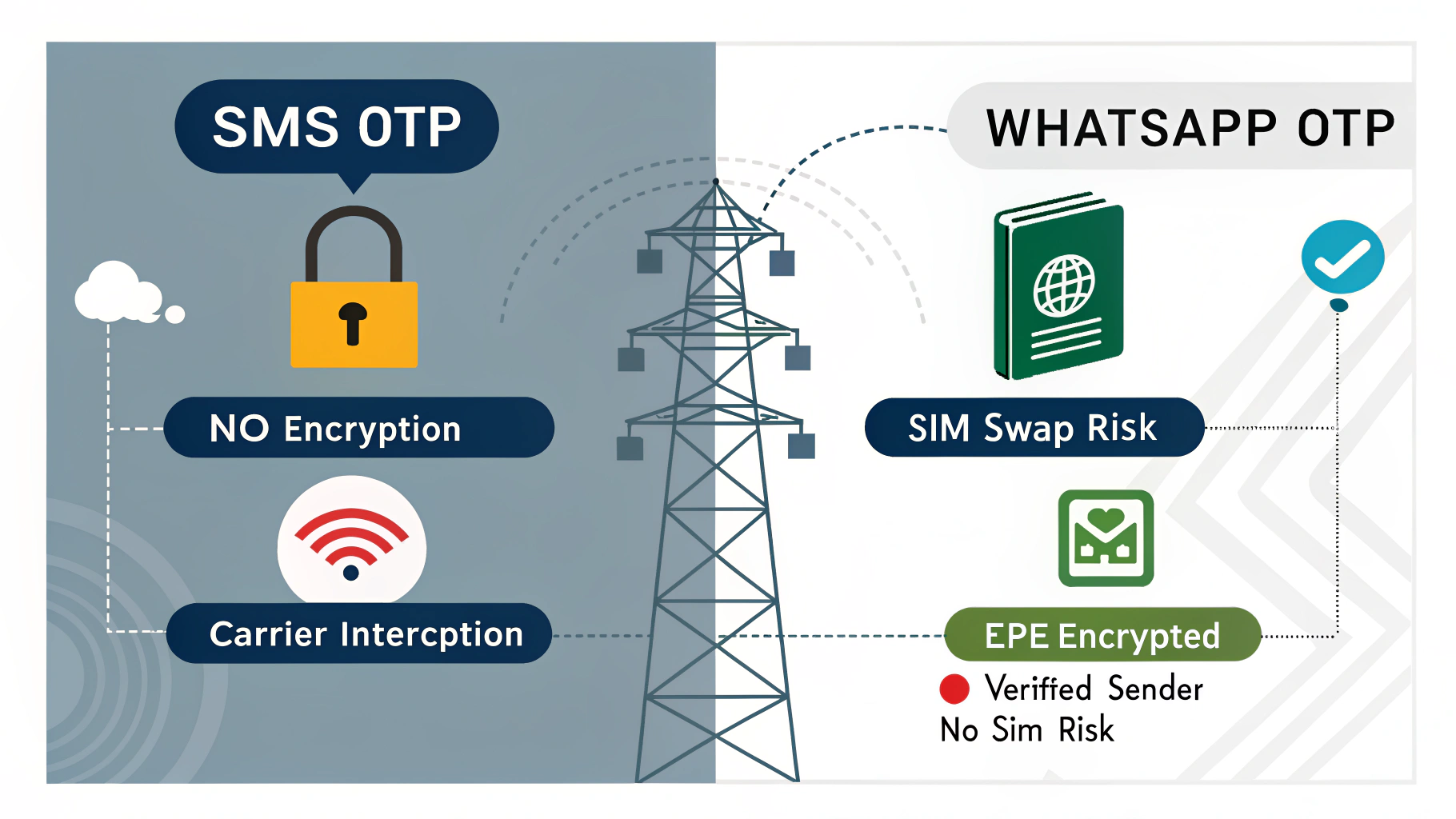
OTP has three serious security vulnerabilities that affect Indian businesses:
SMS
OTP has three serious security vulnerabilities that affect Indian businesses:
•
SIM Swap
Fraud: Fraudsters convince telecom
operators to reassign a victim's mobile number to a new SIM card they control.
Once successful, they intercept all SMS OTPs. Indian banks have reported
thousands of SIM-swap fraud cases annually.
•
SS7 Protocol
Attacks: The underlying telecom
signaling protocol (SS7) has known vulnerabilities that allow sophisticated
attackers to intercept SMS messages in transit.
•
No Encryption:
SMS messages travel as plain text
across multiple carrier networks. Any actor with network access at the carrier
level can potentially read the content.
WhatsApp
OTP addresses all three of these:
✓
End-to-end
encryption: Every WhatsApp message —
including OTPs — is encrypted from your server to the user's device using the
Signal Protocol.
✓
Verified
business sender: Users see your
registered business name and logo, not an unknown alphanumeric code — reducing
phishing risk significantly.
✓
No carrier
dependency: WhatsApp runs over the
internet, bypassing telecom carrier vulnerabilities entirely.
DLT Compliance — The Biggest Hidden Cost of SMS OTP in India
If
you use SMS OTP in India, TRAI's DLT (Distributed Ledger Technology)
regulations apply to every single message you send. Here is what that means in
practice:
•
Header
registration: Your sender ID (e.g.,
NXC-WABA) must be registered and approved before use.
•
Template
pre-registration: Every OTP template
— including the exact variable format like {#var#} — must be registered and
approved. Even a minor deviation causes delivery failure.
•
Ongoing
compliance: Template updates require
re-approval. Regulatory changes require immediate template updates or face
operator blocking.
•
Delivery
delays during campaigns: DLT
verification happens in real-time for each SMS. During high-traffic periods,
DLT processing delays add 3–5+ seconds to delivery time.
|
💡 |
WhatsApp OTP requires NO DLT registration in India. Your
authentication templates are approved once through Meta's platform — which is
faster and requires no ongoing telecom compliance overhead. |
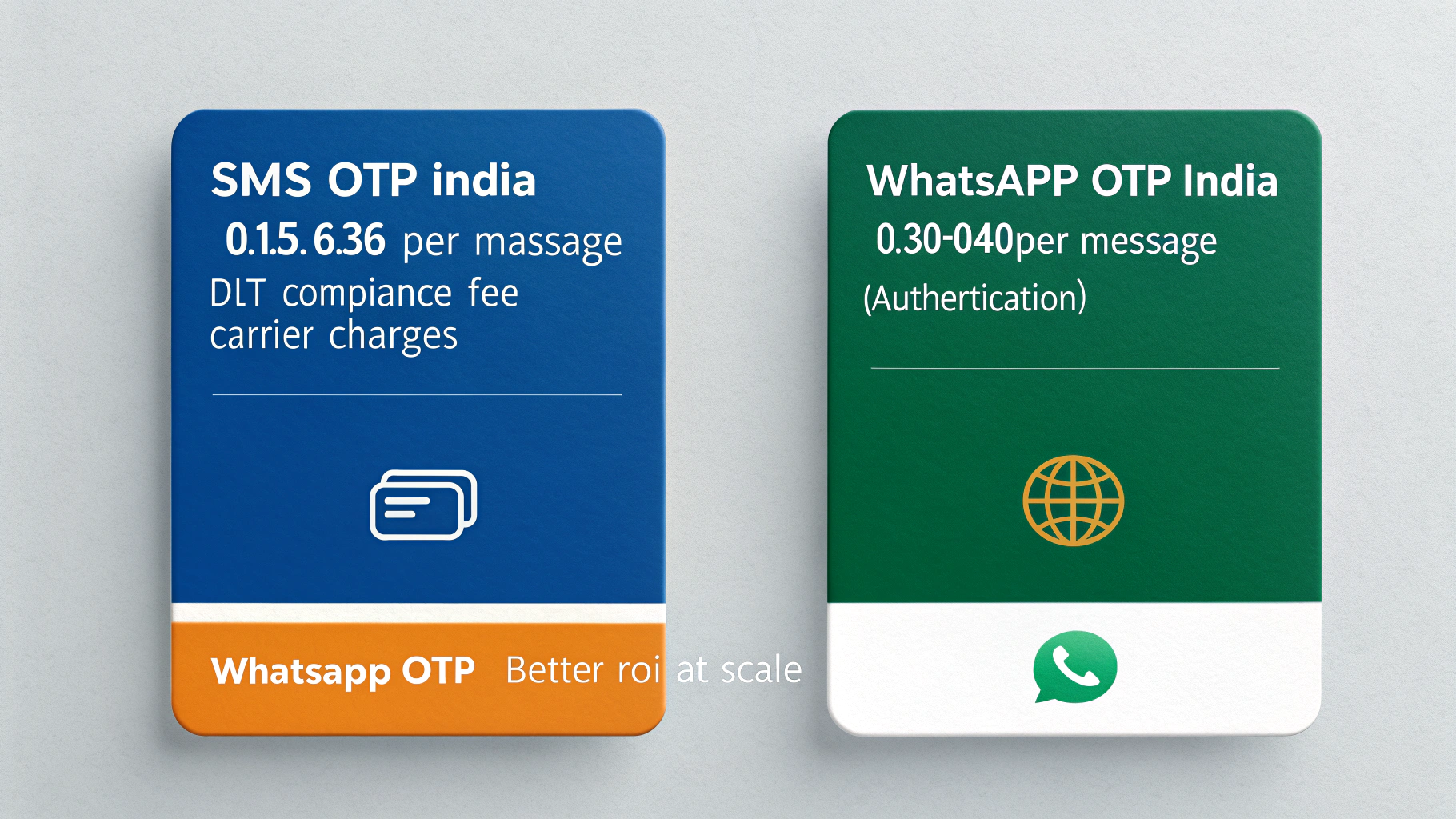
OTP Cost Comparison: WhatsApp OTP vs SMS OTP in India (2026)
At
face value, SMS OTP looks cheaper. But when you factor in the full cost
picture, WhatsApp OTP often delivers better ROI at scale:
|
Cost Factor |
SMS OTP |
|
|
Per
message cost |
₹0.30–0.40
(Auth) |
₹0.15–0.30 |
|
DLT
registration fee |
Not required |
₹ + time +
maintenance |
|
Template
compliance cost |
One-time Meta
approval |
Ongoing TRAI
compliance |
|
Failed
delivery cost |
< 0.5%
failure |
2–6% failure
rate |
|
Re-send
cost (failed OTPs) |
Minimal |
2–6% extra
spend |
|
User
drop-off cost |
Lower (99.5%
delivery) |
Higher
(failed transactions) |
|
Effective
cost at scale |
Higher per
message — lower per conversion |
Cheaper per
message — expensive per failure |
Alt text: WhatsApp OTP vs SMS OTP pricing comparison India 2026
Which Industries Should Use WhatsApp OTP vs SMS OTP in India?
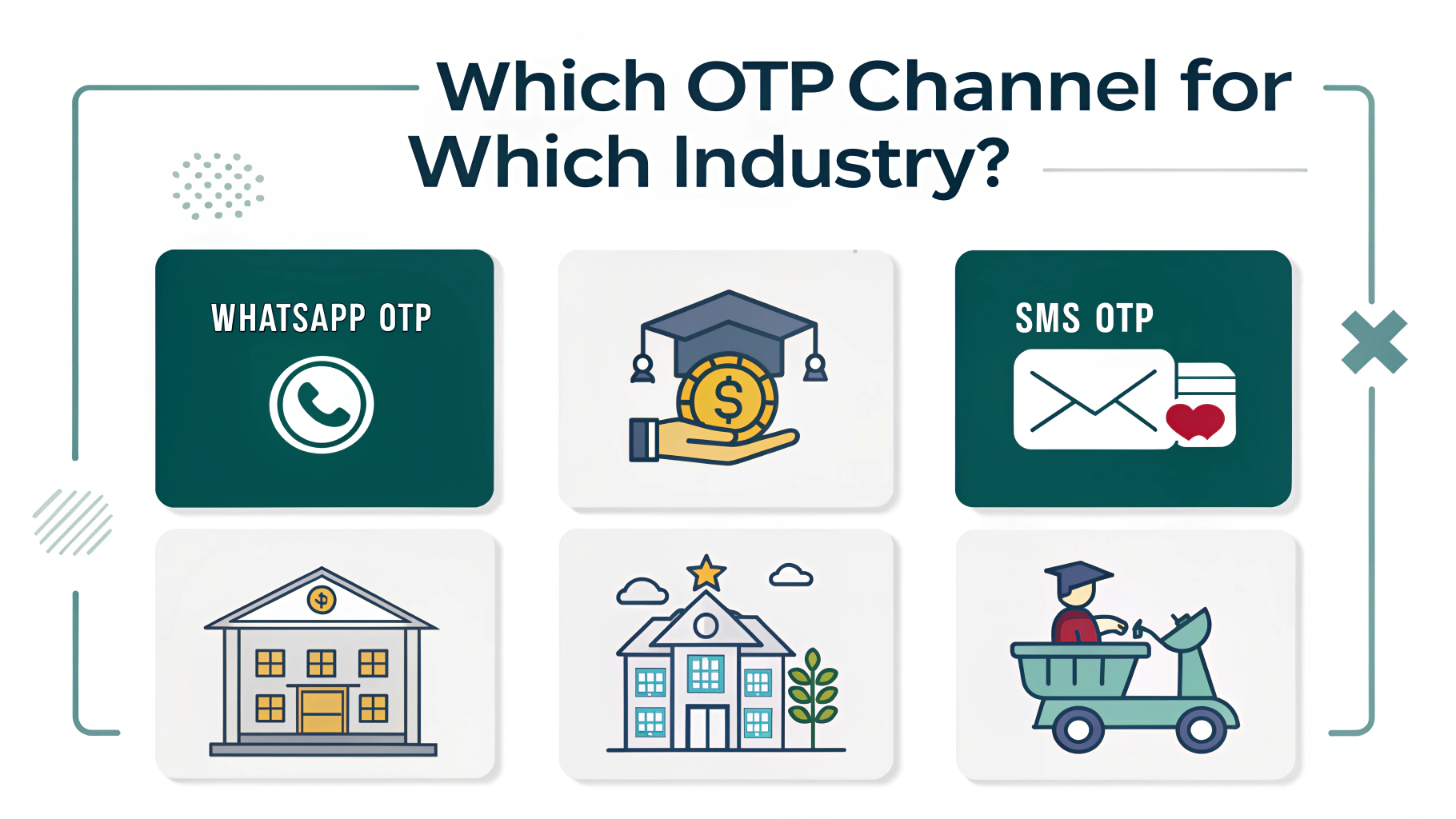
Alt text: WhatsApp OTP vs SMS OTP best industry use cases India
— fintech healthcare ecommerce
|
Industry |
Recommended
Channel |
Why |
Special
Note |
|
Fintech & Banking |
WhatsApp Primary + SMS fallback |
Maximum security + universal reach |
RBI recommends multi-channel by 2026 |
|
eCommerce / D2C |
WhatsApp OTP |
High open rates = fewer abandoned checkouts |
Combine with order update messages |
|
Healthcare |
WhatsApp OTP |
Trusted sender = higher patient compliance |
Use for appointment + OTP |
|
EdTech |
WhatsApp OTP |
Students prefer WhatsApp over SMS |
Link to parent-teacher communication |
|
Real Estate |
SMS OTP |
Wider reach including tier-2 buyers |
Use WhatsApp for follow-ups |
|
Logistics |
WhatsApp Primary |
Delivery agent verification flows |
Works with existing WhatsApp tracking |
|
Rural India Businesses |
SMS OTP |
No internet needed on basic phones |
Add voice OTP as backup |
The Smart Choice: Hybrid OTP Strategy for Indian Businesses
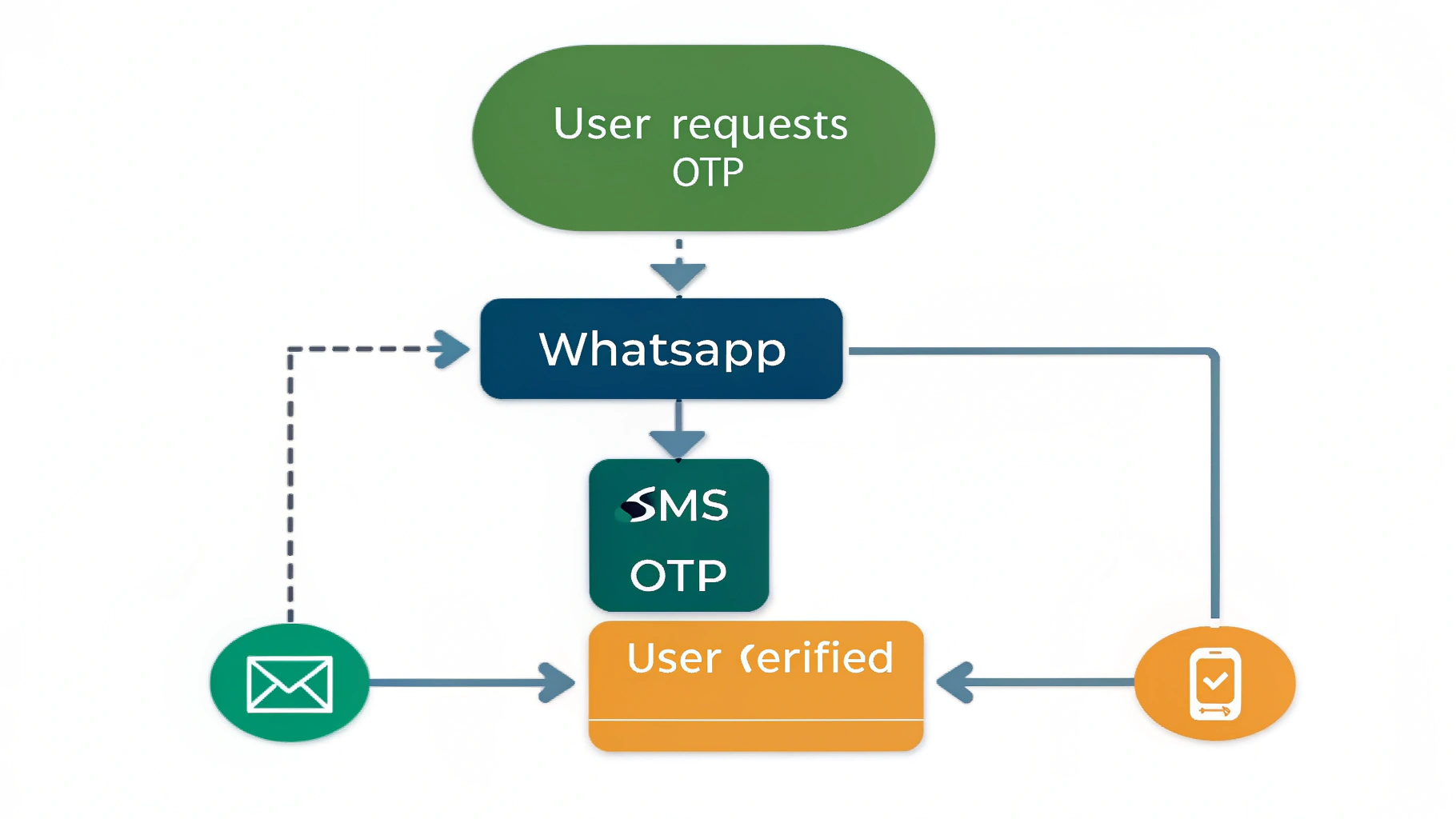
Alt text: WhatsApp OTP with SMS fallback hybrid flow diagram
India
The
most forward-thinking Indian businesses in 2026 are not choosing between
WhatsApp OTP or SMS OTP — they are using both together in a smart fallback
system:
|
Step 1
→ Send WhatsApp OTP first (fastest,
most secure) Step 2 → If undelivered in 8 seconds: auto-trigger
SMS OTP fallback Step 3 → If SMS also fails: trigger Voice OTP (for
low-connectivity regions) Result: 99%+ delivery rate across all user types in India |
Real-world result: A
fintech company in Mumbai implemented WhatsApp OTP with SMS fallback after
struggling with an 8% OTP drop-off rate. Post-implementation, they achieved
99.5% OTP delivery reliability, conversions improved by 12%, and despite a 40%
higher OTP cost, their overall ROI tripled due to recovered transaction
revenue.
WhatsApp OTP vs SMS OTP — The Final Verdict
|
✅ Choose WhatsApp OTP If... |
✅ Choose SMS OTP If... |
|
✓
Your users are urban, smartphone users ✓
You want maximum security (fintech, banking) ✓
You want to eliminate DLT compliance headaches ✓
You want branded, trusted sender identity ✓
You already use WhatsApp Business API ✓
You want interactive buttons and auto-fill |
✓
Your audience includes rural or tier-3 users ✓
You need OTP on feature phones (no smartphone) ✓
Your users may not have WhatsApp installed ✓
You need the absolute lowest cost per message ✓
You want a quick setup with minimal API work ✓
You need a fallback channel for WhatsApp OTP |
|
🏆 |
For most Indian businesses in 2026 — especially fintech, D2C,
healthcare, and edtech — the best strategy is WhatsApp OTP as primary with
SMS as intelligent fallback. This gives you the best of both worlds: superior
speed, security, and user experience, with universal reach. |
Frequently Asked Questions (FAQs)
Q1. Is WhatsApp OTP safer than SMS OTP?
Yes.
WhatsApp OTP is significantly more secure than SMS OTP because it uses
end-to-end encryption (Signal Protocol), sends from a verified business
account, and is not vulnerable to SIM swap fraud or SS7-level carrier
interception — the two most common OTP fraud vectors in India.
Q2. Does WhatsApp OTP require DLT
registration in India?
No.
WhatsApp OTP does not require TRAI DLT registration. Your authentication
templates are approved once through Meta's WhatsApp Business API platform. This
eliminates the DLT compliance overhead, template re-registration delays, and
carrier-level delivery failures that commonly affect SMS OTP in India.
Q3. How much does WhatsApp OTP cost in India
in 2026?
WhatsApp
OTP (Authentication template category) is priced at approximately ₹0.30–0.40
per conversation in India — which covers the entire verification exchange, not
just a single message. SMS OTP typically costs ₹0.15–0.30 per message. While
WhatsApp is slightly more expensive per message, its 99.5% delivery rate and
near-zero re-send cost often makes it more cost-effective at scale.
Q4. Can I use WhatsApp OTP without WhatsApp
Business API?
No.
You must have an active WhatsApp Business API account through a Meta-approved
BSP (Business Solution Provider) to send WhatsApp OTPs. You cannot use the
WhatsApp Business App for OTP delivery. The API gives you access to
Authentication-category templates which are specifically designed for OTP use.
Q5. What happens if the user doesn't have
WhatsApp?
If
a user does not have WhatsApp installed, your WhatsApp OTP will not be
delivered. This is why a hybrid strategy is essential for Indian businesses:
your system should automatically fall back to SMS OTP if the WhatsApp delivery
is not confirmed within 8–10 seconds. A good WhatsApp BSP will support this
fallback natively through their API.
Q6. Is WhatsApp OTP RBI-compliant for
banking transactions?
Yes.
WhatsApp OTP via the official WhatsApp Business API is considered a valid
authentication channel for banking use cases in India. In fact, the RBI has
mandated that banks offer OTP alternatives beyond SMS by April 2026 — making
WhatsApp OTP an increasingly important channel for banks and NBFCs. Always
consult your compliance team to confirm specific regulatory requirements for
your use case.
Q7. How long does WhatsApp OTP template
approval take?
WhatsApp
Authentication template approval through Meta typically takes 3–7 business days
for first-time submissions. Re-submissions or modifications on approved
templates can be faster. Your BSP partner handles the submission process and
can guide you on template formatting to avoid rejection.
Q8. Can WhatsApp OTP auto-fill on Android
phones?
Yes.
WhatsApp supports native OTP auto-fill on Android devices. When a user receives
a WhatsApp OTP, Android recognizes it as a verification code and offers a
one-tap auto-fill option — eliminating manual copying and reducing user
friction significantly compared to SMS OTP.
Conclusion — WhatsApp OTP Is the Future, SMS OTP Is the Safety Net
The
answer to 'WhatsApp OTP vs SMS OTP — which is better for Indian businesses?' is
not a simple either/or choice. It is a strategic combination.
WhatsApp
OTP wins on every quality metric: faster delivery, better security, higher open
rates, no DLT hassle, and a branded trusted experience that builds customer
confidence. SMS OTP wins on one critical dimension: universal reach —
especially for rural India and feature phone users.
The
smartest Indian businesses in 2026 are using WhatsApp OTP as their primary
channel and SMS as an intelligent fallback. This hybrid approach delivers 99%+
OTP delivery across all user segments while keeping costs under control and
compliance risk minimal.
|
🚀 |
Ready to implement WhatsApp OTP for your business? Set up your
WhatsApp Business API account with a Meta-approved BSP and start delivering
faster, more secure OTPs today. [Link to your WhatsApp Business API Setup
service page] |