

Jun 24, 2026
What is AI? Learn how Artificial Intelligence works, types of AI, real-world examples, benefits, and why AI is trending in 2026. Simple, complete beginner-friendly guide.
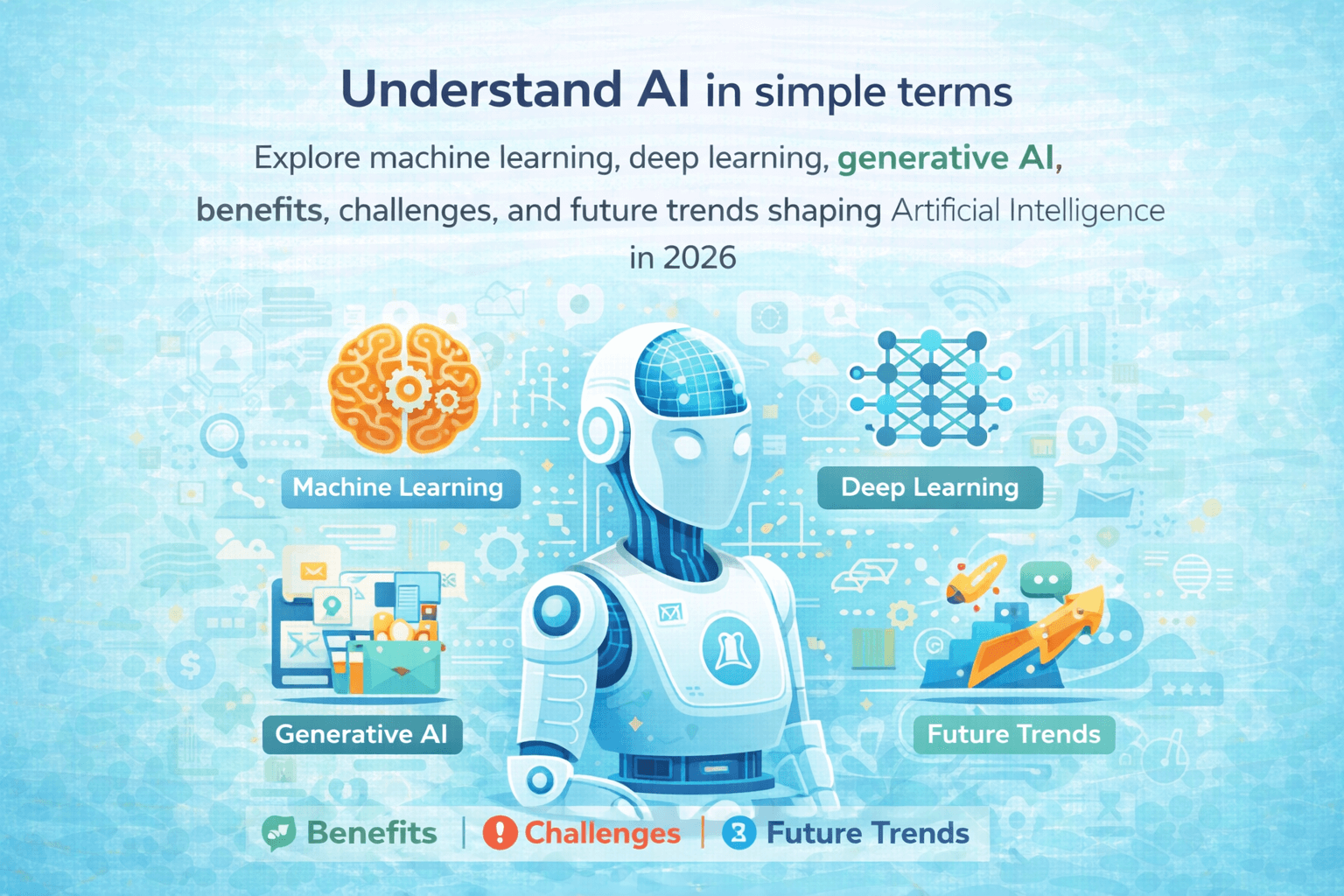
What Is AI? (Artificial Intelligence Explained in 2026)
Introduction
Artificial Intelligence (AI) refers to computer systems
designed to perform tasks that normally require human intelligence. These tasks
include learning from data, understanding language, recognizing images, making
decisions, and solving problems.
With new AI models launching rapidly in 2026, interest in AI
continues to peak as businesses and individuals explore its real-world
applications.
What Is Artificial Intelligence?
Artificial Intelligence is a branch of computer science that
enables machines to simulate human intelligence. Instead of following fixed
rules, AI systems learn from data patterns and improve over time.
AI technologies power tools like:
• Chatbots (ChatGPT, AI assistants)
• Image generators
• Recommendation systems (Netflix, Amazon)
• Voice assistants (Alexa, Siri)
• Self-driving vehicles
• Fraud detection systems
AI works using:
1️ Machine Learning (ML)
Algorithms that learn from historical data to make
predictions.
2️ Deep Learning
Advanced neural networks that process complex data like
images and speech.
3️ Natural Language Processing
(NLP)
Helps machines understand and generate human language.
4️ Generative AI
Creates content such as text, images, code, music, and
videos.
Types of AI
• Narrow AI (Weak AI) – Designed for
specific tasks (e.g., chatbots, recommendation engines)
• General AI (AGI) – Theoretical AI with
human-like intelligence
• Super AI – Hypothetical advanced
intelligence beyond human capabilities
Currently, most AI systems are Narrow AI.
AI is peaking due to:
• Rapid release of advanced AI models
• Business automation demand
• AI integration in marketing & customer support
• Rise of generative AI tools
• Increased investment in AI startups
• AI-powered search and productivity tools
Companies are adopting AI to improve efficiency, reduce
costs, and increase personalization.
Benefits of AI
• Automates repetitive tasks
• Improves decision-making accuracy
• Enhances customer experience
• Boosts productivity
• Reduces operational costs
• Enables data-driven marketing
Challenges of AI
• Data privacy concerns
• Bias in AI models
• Job displacement fears
• Regulatory and ethical issues
• High infrastructure costs
Future of AI
AI is expected to transform industries like healthcare,
finance, education, retail, and manufacturing. With continuous innovation, AI
will become more integrated into daily life and business operations.