
Jun 24, 2026
What is an AI agent and how does it work? This plain-English beginner's guide explains AI agents, how they differ from chatbots, and what they mean for your business.
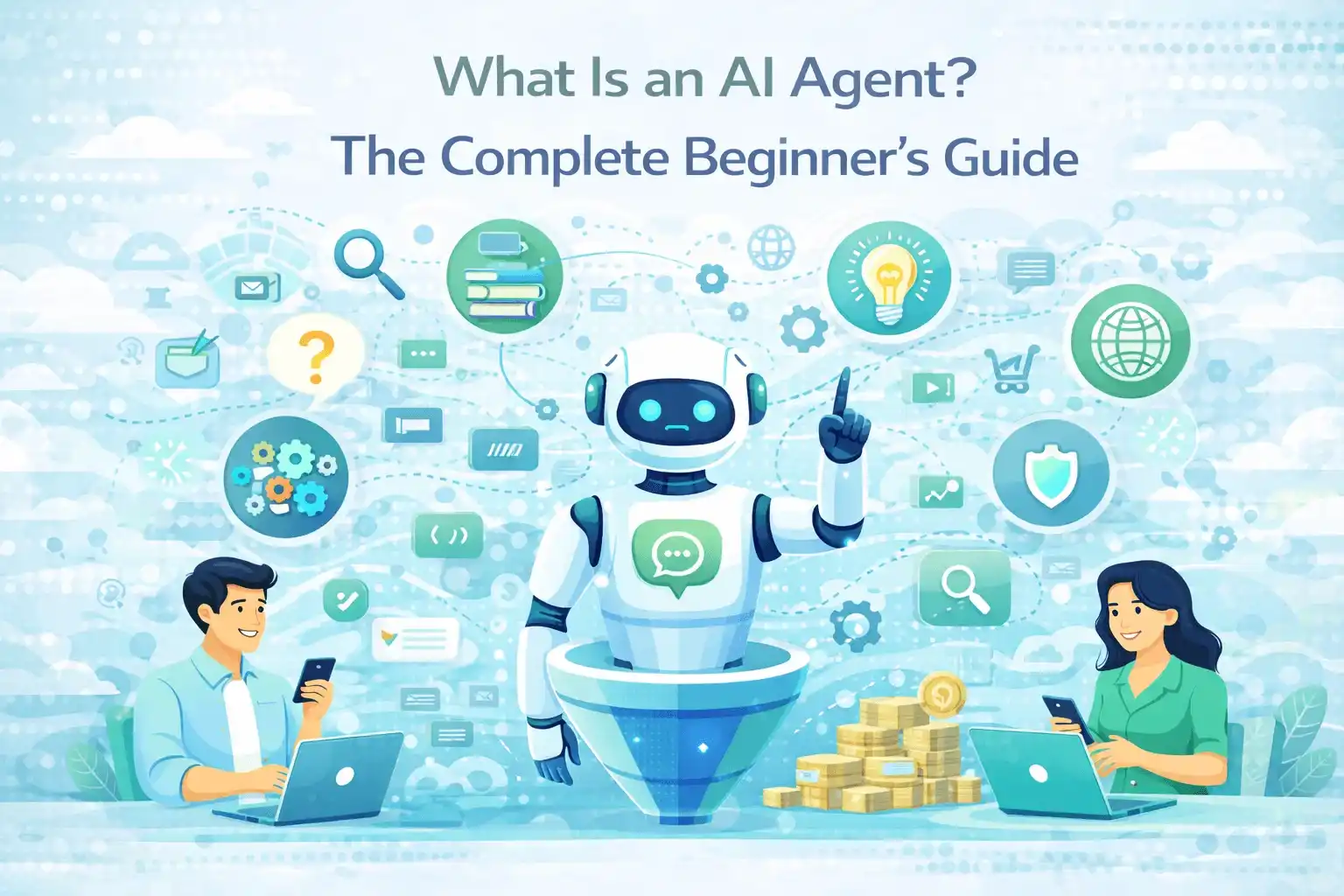
AI agent. You have been hearing the phrase everywhere — in tech headlines, business podcasts, LinkedIn posts, and boardroom conversations. It sounds important. It sounds complex. And if you have tried to look it up, you have probably encountered explanations dense with technical jargon that leave you more confused than when you started.
This guide is different. It is written for business owners, marketers, and professionals who want to understand what an AI agent actually is — in plain English — without needing a computer science degree to follow along. We will cover what AI agents are, how they work, what they can do, how they differ from the chatbots and automation tools you already know, and most importantly, what they mean for your business right now in 2026.
By the end of this guide, you will have a clear, confident understanding of one of the most significant technology developments happening in business today. And you will know exactly where to start if you want to explore how AI agents could work for you.
$47.1B AI Agent Market Size Projected by 2030 | 44% Annual Market Growth Rate (CAGR) | 82% Of Companies Plan to Deploy AI Agents by 2027 |
327% Growth in AI Agent Deployments 2023–2026 | 40% Reduction in Process Costs With AI Agents | 70% Faster Time-to-Insight in Data-Heavy Operations |
1. What Is an AI Agent — The Plain-English Definition
An AI agent is a software system that can perceive information from its environment, reason about what needs to be done, take actions to accomplish a goal, and learn from the results — all with the ability to operate with minimal or no human intervention once it has been set up and given a task.
That definition covers a lot of ground, so let us break it down with a concrete comparison. When you ask a search engine a question, it finds and displays relevant results — it does one thing, immediately, in response to your input. When you use a standard chatbot, it responds to your messages in a conversation — again, reactive, limited to a single interface. An AI agent is different: you give it a goal, and it figures out how to achieve that goal by itself — using whatever tools, data sources, and steps are necessary, in whatever order makes sense, adapting along the way when it encounters obstacles.
AI Agent vs. AI Chatbot — What Is the Difference?
This is the most common point of confusion, so let us address it directly. A chatbot is designed for conversation — it answers questions, responds to messages, and guides visitors through a scripted or AI-generated dialogue within a single interface. It is reactive: it waits for you to say something, then responds. It does not do anything beyond the conversation itself.
An AI agent is designed for action. It does not just respond to your messages — it executes tasks. It can browse the internet, write and send emails, update your CRM, analyse data, write and run code, book appointments, generate reports, and coordinate across multiple tools and systems simultaneously. You give an AI agent a goal, not a question. It then works out what steps are needed to achieve that goal and carries them out — often across multiple systems and over an extended period — without you needing to direct each step.
AI Agent vs. Traditional Automation — Key Distinctions
Traditional automation — the kind you might already use for things like email sequences, data exports, or scheduled reports — follows fixed, pre-defined rules. If X happens, do Y. It is reliable, efficient, and valuable within its defined parameters. But it breaks the moment something outside those parameters occurs. It cannot adapt. It cannot reason. It cannot handle ambiguity.
An AI agent reasons about situations. If it encounters an unexpected obstacle mid-task, it does not stop and wait for a human to reprogram it — it evaluates the options, makes a judgement call, and finds an alternative path to the goal. This ability to reason, adapt, and pursue goals flexibly is what separates AI agents from everything that came before them in the automation landscape.
The Three Things That Make Something a True AI Agent
• Goal orientation — it works toward an objective, not just through a pre-defined script
• Tool use — it can access and operate external tools, APIs, databases, and systems to complete tasks
• Autonomous reasoning — it makes decisions about how to proceed without requiring explicit human instruction at each step
2. How Do AI Agents Work?
Understanding how AI agents work does not require a technical background — the core process is actually very intuitive once you understand the four phases involved. Every AI agent — regardless of how sophisticated it is — operates through the same fundamental cycle.
👁️ PERCEIVE | How AI Agents Observe the World An AI agent starts by gathering information — from the input you give it, from the tools and data sources it has access to, from the results of its previous actions, and from any other relevant context in its environment. This might mean reading an email, browsing a web page, querying a database, or reviewing the output of a previous task. The agent is constantly taking in information to inform its next decision. |
🧠 REASON | How AI Agents Make Decisions Once the agent has gathered relevant information, it reasons about what needs to happen next to make progress toward its goal. This is where the AI — typically a large language model (LLM) at the core — evaluates the situation, considers the options available, weighs their likely outcomes, and decides on a course of action. This reasoning step is what distinguishes an AI agent from a simple rule-following script. |
⚡ ACT | How AI Agents Execute Tasks The agent then carries out its chosen action — this might mean writing and sending an email, searching the web for information, updating a spreadsheet, making an API call to an external service, writing code and running it, or any number of other real-world actions depending on what tools the agent has access to. A sophisticated AI agent may use dozens of different tools in the course of completing a single task. |
📈 LEARN | How AI Agents Improve Over Time After taking an action, the agent observes the result — did the action achieve the intended outcome? If so, that reinforces the approach. If not, the agent adjusts its strategy and tries a different approach. Over time, this feedback loop makes the agent progressively more effective at achieving its goals in its specific domain. |
These four phases — Perceive, Reason, Act, Learn — repeat continuously as the agent works toward its goal. A complex task might involve hundreds of cycles of this loop, with the agent gathering information, making decisions, taking actions, observing results, and adjusting its approach at every step — until the goal is achieved.
3. Types of AI Agents — From Simple to Fully Autonomous
Not all AI agents are equal in capability or complexity. The field of AI defines a spectrum of agent types, from the most basic reactive systems to fully autonomous, continuously learning agents. Here is each type explained in plain English.
Simple Reflex Agent | How it decides: Responds to current input only — no memory, no history, no context beyond the immediate moment. Best for: Basic trigger-response automation where the situation is always clear and predictable. Example: A smart thermostat that turns on the heating when the temperature drops below a set threshold. |
Model-Based Agent | How it decides: Uses both current input and an internal model of the world — remembers past states and uses that context to make better decisions. Best for: Situations where context and history matter for the correct response. Example: A GPS navigation system that knows your current location, your destination, current traffic, and road conditions — and adjusts the route accordingly. |
Goal-Based Agent | How it decides: Works backward from a defined goal — evaluates which actions are most likely to achieve the desired end state. Best for: Task completion scenarios where the path to the goal is not fixed in advance. Example: An AI booking assistant given the goal of scheduling a meeting for three people across three time zones — it evaluates calendar availability, time zone differences, and preferences to find the optimal slot. |
Utility-Based Agent | How it decides: Selects actions that maximise a defined utility score — not just achieving a goal but achieving it in the optimal way. Best for: Optimisation tasks where there are multiple acceptable outcomes but some are clearly better than others. Example: An AI bid management system that maximises ad ROI — it does not just win auctions but wins them at the most efficient price point. |
Learning Agent | How it decides: Learns from experience — improves its performance over time based on the results of its past actions without being explicitly reprogrammed. Best for: Any application where performance should improve with use and data accumulation. Example: A content recommendation engine that becomes more accurate at predicting what each individual user will engage with as it learns from their behaviour history. |
Multi-Agent System | How it decides: Multiple specialised AI agents collaborate — each handling a specific component of a complex workflow, coordinating their outputs to complete tasks too large for any single agent. Best for: Complex, multi-domain workflows that benefit from specialisation and parallel processing. Example: A multi-agent sales system where a research agent, a copywriting agent, an outreach agent, and a scheduling agent each handle their specialist function to run an end-to-end outbound campaign. |
4. Real-World Examples of AI Agents in Action
The most effective way to understand what AI agents actually do is through concrete examples from the business functions you already know. Here is what AI agents are doing in the real world right now.
AI Agents in Customer Service
Customer service AI agents go significantly further than chatbots. A customer service AI agent does not just answer questions — it takes action. It can look up an order in your fulfilment system, process a return request, issue a refund through your payment gateway, update the customer's account record, send a confirmation email, and flag the case for follow-up review — all within a single conversation, without human involvement. Companies using customer service AI agents report handling up to 80% of routine service requests without any human agent involvement, with customer satisfaction scores matching or exceeding human-staffed service teams.
AI Agents in Sales and Lead Generation
Sales AI agents are transforming the top of the B2B sales funnel. A sales AI agent can research a list of target companies, identify the correct decision-makers at each company, gather relevant context about each prospect from public sources, draft highly personalised outreach emails for each individual, send those emails, track who opens and clicks, follow up intelligently based on engagement signals, and book discovery calls directly into sales reps' calendars — running an entire outbound prospecting workflow autonomously. What previously required a full SDR team now runs with minimal human oversight.
AI Agents in Marketing Automation
Marketing AI agents monitor campaign performance across all channels in real time, identify underperforming ads and pause them, generate new creative variations for testing, adjust bid strategies based on conversion data, update audience segments based on behavioural signals, and generate performance reports with recommended actions. The most advanced marketing AI agents can plan, launch, and optimise entire multi-channel campaigns with human oversight limited to strategic approval at key decision points.
AI Agents in Software Development
Coding AI agents — like GitHub Copilot Workspace, Devin, and Claude's computer use capability — can read a technical specification, write the code needed to implement it, run the code to test for errors, debug failures, iterate until the implementation works correctly, write documentation, and submit the code for human review. For well-defined development tasks, AI coding agents can complete in minutes what previously took a developer hours or days.
AI Agents in Finance and Operations
Financial AI agents monitor transaction data in real time, flag anomalous patterns that may indicate fraud or error, generate regulatory compliance reports, reconcile accounts across multiple systems, and produce financial summaries with commentary — all automatically. Operations AI agents manage inventory levels, trigger purchase orders when stock falls below defined thresholds, coordinate with suppliers, update logistics systems, and generate supply chain reports without human coordination at each step.
AI Agents in E-Commerce
E-commerce AI agents handle product recommendation personalisation, dynamic pricing optimisation, abandoned cart recovery sequences, customer service enquiries, inventory management, and supplier communication — running the operational layer of an online store with dramatically reduced manual involvement. The most sophisticated e-commerce AI agents monitor competitor pricing in real time and adjust pricing automatically within approved parameters to maintain competitive positioning and margin targets simultaneously.
5. AI Agent vs. AI Chatbot vs. Traditional Automation — Full Comparison
Capability | Traditional Automation | AI Chatbot | AI Agent |
Task Type | Single predefined tasks | Conversation only | Multi-step, complex tasks |
Decision Making | Rule-based only | Conversational responses | Autonomous reasoning |
Tool Use | None | Very limited | 50+ tools and APIs |
Self-Correction | None | None | Yes — adapts from errors |
Goal Orientation | Fixed steps | Guided conversation | Pursues defined goals |
Human Supervision | Required for changes | Minimal | Minimal once configured |
Learning Over Time | No | Limited | Continuous improvement |
Cross-System Action | No | No | Yes — across all systems |
Initiative | Reactive only | Reactive only | Proactive and reactive |
Complexity Handled | Low | Low to Medium | Low to Very High |
6. The Rise of Autonomous AI Agents in 2026
Why 2026 Is the Breakthrough Year for AI Agents
AI agents are not a new concept — researchers have been working on autonomous agent systems for decades. What has changed dramatically in the past two years is the underlying technology that makes truly capable AI agents possible at a practical business level. The emergence of large language models like GPT-4, Claude, and Gemini — with their ability to reason about complex situations, understand nuanced instructions, and generate contextually appropriate responses — has provided the cognitive engine that AI agents needed to move from research curiosity to business reality.
Simultaneously, the ecosystem of tools, APIs, and integrations that AI agents can access has exploded. An AI agent in 2026 can natively interact with email, calendars, CRM systems, web browsers, databases, payment systems, communication platforms, and thousands of other business tools through API connections — giving it the hands it needs to act on its reasoning. The combination of powerful reasoning and rich tool access is what makes 2026 the year AI agents go from impressive demonstration to genuine business deployment.
Multi-Agent Systems — When AI Agents Work Together
Some of the most powerful applications of AI agents involve not a single agent working alone but multiple specialised agents collaborating on a complex workflow. In a multi-agent system, each agent has a defined specialisation — a research agent, a writing agent, a quality-checking agent, a scheduling agent — and they coordinate their outputs to complete tasks that are too large, too complex, or too multi-disciplinary for any single agent to handle effectively.
Multi-agent systems are already being used to run end-to-end marketing campaigns, manage complete customer service operations, execute full software development workflows, and conduct complex business research — with human oversight limited to strategic direction and approval at key checkpoints rather than involvement in every step of execution.
What Agentic AI Means for the Future of Work
The rise of AI agents raises legitimate and important questions about the future of work. The most accurate framing is not replacement but redeployment. AI agents are exceptionally good at high-volume, multi-step, rule-followable tasks — the kind of work that consumes significant time but does not require genuine creativity, strategic judgement, or human relationship depth. As AI agents absorb this category of work, human professionals are freed to focus on the work that genuinely benefits from human qualities — strategic thinking, creative problem-solving, empathy-led relationship management, and ethical judgement.
🚀 Looking Ahead: The most valuable professional skill of the next decade is not competing with AI agents — it is knowing how to direct, manage, and get the most out of them. The professionals and business owners who build expertise in AI agent deployment and management today will have an enormous advantage as agentic AI becomes mainstream across every industry. |
7. Benefits of AI Agents for Business
Automate Complex Multi-Step Workflows
The defining business benefit of AI agents is their ability to handle complex, multi-step workflows that were previously impossible to automate — because they required reasoning, adaptation, and tool use that traditional automation could not provide. Lead research and personalised outreach, end-to-end customer service case resolution, multi-channel campaign management, financial reporting and reconciliation, and software development and testing are all examples of workflows that AI agents can now execute with minimal human involvement.
Operate 24/7 Without Human Supervision
AI agents do not have working hours. They do not have sick days, annual leave, or fatigue. Once configured and running, an AI agent operates continuously — monitoring for relevant events, taking appropriate actions, and making progress toward its goals around the clock. For businesses with global operations or time-sensitive workflows, this continuous operation capability is transformatively valuable. A sales AI agent that identifies and follows up with a high-intent website visitor at 3am captures an opportunity that would have been missed by any human team.
Scale Operations Without Proportional Headcount Growth
Traditional business scaling follows a broadly linear pattern — more revenue requires more operations, which requires more people. AI agents break this relationship. A single AI agent can handle the workload of multiple human workers for defined task categories. A team of ten AI agents can handle the workload of a department. And the incremental cost of an AI agent handling ten times the volume is a fraction of the cost of hiring ten times the people. For growth-stage businesses, this represents one of the most significant operational leverage opportunities available.
Make Better Decisions Faster With Real-Time Data
AI agents process and act on information far faster than human decision-makers can. A marketing AI agent monitoring campaign performance can identify an underperforming ad, pause it, generate a replacement creative, launch the new ad, and begin monitoring its performance — in the time it would take a human to open their laptop and log into the ad platform. This speed advantage compounds over hundreds of decisions per day across complex operations, producing measurably better outcomes than human-paced decision cycles.
Reduce Human Error in Repetitive Processes
Human error in repetitive processes — data entry mistakes, missed follow-ups, inconsistent application of rules, copy-paste errors — is one of the most pervasive sources of operational cost and customer experience degradation in most businesses. AI agents execute repetitive processes with perfect consistency, every time, without the attention fatigue that causes human error rates to rise with task volume. For data-sensitive operations like financial processing, compliance checking, and CRM data management, this consistency advantage alone often justifies the investment.
8. Challenges and Limitations of AI Agents
An honest assessment of AI agents includes their limitations as well as their capabilities. Understanding these challenges is essential for deploying AI agents safely and effectively.
Hallucinations and Accuracy Issues
The large language models at the core of most AI agents can sometimes generate information that sounds confident and plausible but is factually incorrect — a phenomenon known as hallucination. For business deployments, this means AI agents should not be given unsupervised authority over decisions where factual accuracy is critical and errors would be costly — financial advice, medical information, legal guidance, or any output that will be presented to customers without human review. Mitigating hallucinations requires using agents with access to verified data sources, implementing verification steps in agent workflows, and maintaining human review for high-stakes outputs.
Security and Data Privacy Concerns
AI agents that have access to multiple business systems and customer data must be deployed with robust security protocols. Key considerations include ensuring the agent only has access to the data and systems it genuinely needs for its defined tasks, encrypting all data in transit and at rest, maintaining detailed logs of all agent actions for auditability, complying with GDPR and applicable data protection regulations in all markets the agent operates in, and conducting regular security reviews of agent access permissions and data handling practices.
The Need for Human Oversight
AI agents are powerful tools that benefit enormously from appropriate human oversight — particularly during initial deployment. Define clearly which decisions the agent can make autonomously and which require human approval. Establish regular review processes to check agent outputs for quality and accuracy. Create easy escalation paths for situations the agent cannot handle appropriately. And build monitoring systems that alert human operators when the agent's behaviour deviates from expected patterns. AI agents are most valuable when humans set the strategic direction and the agent handles the execution — not when agents are left entirely unsupervised.
Cost and Complexity of Implementation
While AI agent platforms have become significantly more accessible, implementing them effectively still requires investment — in platform costs, in the time needed to define workflows and train the agent on your specific business context, and in ongoing management and optimisation. The cost is almost always justified by the operational savings and capability gains, but it is important to approach implementation with realistic expectations about the time and resource investment required, particularly for complex, multi-system integrations.
Starting with AI agents does not require a large technology budget or an in-house AI team. It requires a clear use case, the right platform, and a disciplined approach to deployment. Follow these five steps.
1 | Identify the Right Use Cases Start by mapping your business operations to find the tasks that are high-volume, repetitive, rule-followable, time-consuming for your team, and low-risk if the agent makes an occasional error. Common starting use cases include lead research and initial outreach, customer support FAQ handling, appointment scheduling, data entry and CRM updating, and content drafting. Avoid starting with tasks that are complex, judgement-heavy, or where errors would have significant consequences. |
2 | Choose Your AI Agent Platform Select a platform that fits your use case, your technical capability, and your budget. For non-technical business users, platforms like Zapier AI, Make.com, and Relevance AI offer agent capabilities without coding requirements. For more sophisticated deployments, platforms like AutoGPT, CrewAI, and Microsoft Copilot Studio offer greater flexibility and customisation. If you want a managed solution, specialist AI agencies can build and deploy custom agents tailored to your specific workflows. |
3 | Start With a Single Agent, Single Task Resist the temptation to automate everything at once. Start with one AI agent handling one clearly defined task. Run it in parallel with your existing process for the first two to four weeks — comparing agent outputs to what your team would have done — to validate quality before giving the agent full autonomy. The learning from your first agent deployment will make every subsequent deployment faster and more effective. |
4 | Define Guard Rails and Human Oversight Before launching your agent, define explicitly: what it can do autonomously, what requires human approval, what it should never do, how it should handle situations it cannot resolve, and who monitors its outputs and how often. Build these guard rails into the agent's configuration from day one — it is far easier to loosen restrictions as you build trust than to recover from an unconstrained agent making costly errors. |
5 | Measure, Iterate, and Expand Track the agent's performance against the manual baseline — time saved, error rate, output quality, and business outcomes achieved. Use this data to optimise the agent's configuration, refine its instructions, and expand its capabilities incrementally. Once your first agent is running reliably, apply the same process to a second use case — building a portfolio of AI agents that progressively handles more of your operational workload. |
10. Top AI Agent Platforms and Tools in 2026
General-Purpose AI Agent Platforms
AutoGPT is one of the pioneering open-source AI agent frameworks — giving you a fully autonomous agent that can browse the web, write and execute code, manage files, and interact with external services. CrewAI specialises in multi-agent systems — allowing you to define teams of specialised AI agents that collaborate on complex tasks. Microsoft Copilot Studio provides enterprise-grade AI agent building with deep integration into the Microsoft 365 ecosystem. Relevance AI offers a no-code platform for building and deploying AI agents across business workflows without technical expertise.
Business-Specific AI Agent Tools
For sales teams, Clay combines AI agent capabilities with the world's largest B2B data network to automate prospect research, personalisation, and outreach. For customer service, Intercom Fin and Freshworks Freddy AI handle end-to-end customer service automation. For marketing, Albert.ai operates as a fully autonomous AI marketing agent across paid channels. For software development, GitHub Copilot Workspace and Devin represent the leading AI coding agent implementations available today.
Developer Frameworks for Building AI Agents
For businesses with technical teams who want to build custom AI agents, LangChain and LlamaIndex are the most widely used open-source frameworks for building applications powered by large language models. The Anthropic API (Claude), OpenAI API (GPT-4o), and Google Gemini API provide the underlying model intelligence that powers custom agent implementations. Amazon Bedrock and Microsoft Azure AI provide enterprise-grade cloud infrastructure for deploying AI agents at scale with strong security and compliance controls.
Frequently Asked Questions (FAQ)
These FAQs target the highest-volume search queries around AI agents and are structured for featured snippet ranking.
Q: What is an AI agent in simple terms?
A: An AI agent is a software system that can perceive information, make decisions, take actions, and learn from results — all with the goal of completing a task with minimal human intervention. Unlike a chatbot that only answers questions, an AI agent can browse the web, send emails, update databases, write code, and coordinate across multiple tools to complete complex, multi-step tasks autonomously. Think of it as giving a piece of software a goal and letting it figure out how to achieve it.
Q: What is the difference between an AI agent and a chatbot?
A: A chatbot is designed for conversation — it responds to messages within a single interface. An AI agent is designed for action — it can perceive information from multiple sources, reason about the best course of action, use external tools and APIs, and execute multi-step tasks across different systems. A chatbot answers your question. An AI agent completes your task. The key distinction is that AI agents can take initiative, use tools, and operate across multiple systems without being confined to a single conversational interface.
Q: What are examples of AI agents in business?
A: Real-world business examples include: a sales AI agent that researches prospects, drafts personalised emails, sends outreach, and books meetings automatically; a customer service AI agent that handles enquiries, processes refunds, and updates account records without human involvement; a marketing AI agent that monitors campaign performance, pauses underperforming ads, and generates new creative variations; a coding AI agent that writes, tests, and debugs code from a specification; and a finance AI agent that reconciles accounts, flags anomalies, and generates compliance reports.
Q: Are AI agents safe to use for business?
A: AI agents are safe for business when implemented with appropriate guard rails, clear boundaries on autonomous action, human oversight for consequential decisions, and strong data security measures. Best practices include starting with low-risk, reversible tasks, defining clearly what the agent can and cannot do autonomously, maintaining audit logs of all agent actions, and choosing platforms with strong security and compliance certifications. AI agents are safe and valuable when managed responsibly with appropriate human oversight.
Q: How much do AI agents cost?
A: Costs vary widely. General-purpose open-source frameworks like AutoGPT and CrewAI are free to use, with API costs for the underlying language model. Business-focused AI agent platforms typically cost £100 to £2,000 per month depending on features, volume, and integrations. Custom-built AI agent solutions from specialist agencies range from £5,000 to £50,000+ for initial build, with ongoing operational costs. The most relevant benchmark is not the platform fee but the value of the work the agent replaces or enables — most business AI agent deployments achieve positive ROI within three to six months.
Q: What is a multi-agent system?
A: A multi-agent system is an architecture where multiple specialised AI agents work together — each handling a specific component of a complex workflow — to complete tasks too large for any single agent. For example, a multi-agent sales system might use a research agent to identify prospects, a writing agent to draft personalised outreach, an outreach agent to send and track emails, and a scheduling agent to book discovery calls — all coordinating automatically to run an end-to-end outbound sales workflow.
Q: What is the difference between an AI agent and traditional automation?
A: Traditional automation follows fixed, pre-defined rules — if A happens, do B. It cannot adapt when circumstances change and breaks when it encounters anything outside its programmed parameters. An AI agent reasons about situations, makes judgements, adapts to unexpected inputs, uses tools dynamically, and pursues goals rather than following fixed steps. Traditional automation is a rigid script. An AI agent is a flexible, reasoning system that can handle ambiguity, make decisions, and complete tasks in ways that were not explicitly pre-programmed.
Conclusion: AI Agents Are Here — The Question Is How You Use Them
AI agents represent the most significant shift in how businesses can deploy software since the advent of the internet. The ability to give a software system a goal and have it reason, act, learn, and iterate toward achieving that goal — across multiple tools, systems, and time horizons — opens a category of business automation and operational capability that simply did not exist two years ago.
Understanding what AI agents are — and are not — is the first and most important step. They are not magic. They are not infallible. They require thoughtful deployment, appropriate oversight, and continuous optimisation. But for businesses that approach them with clear use cases, realistic expectations, and a commitment to responsible implementation, they offer genuine and measurable competitive advantage.
The businesses that understand AI agents today are the ones who will be deploying them effectively tomorrow — while their competitors are still trying to understand what they are. You have made a strong start. The next step is identifying where in your business an AI agent could create the most value, and taking the first step toward making it real.