Jun 24, 2026
Telegram vs WhatsApp — which platform is right for your audience? Compare features, privacy, business tools, and marketing potential in this 2026 guide.
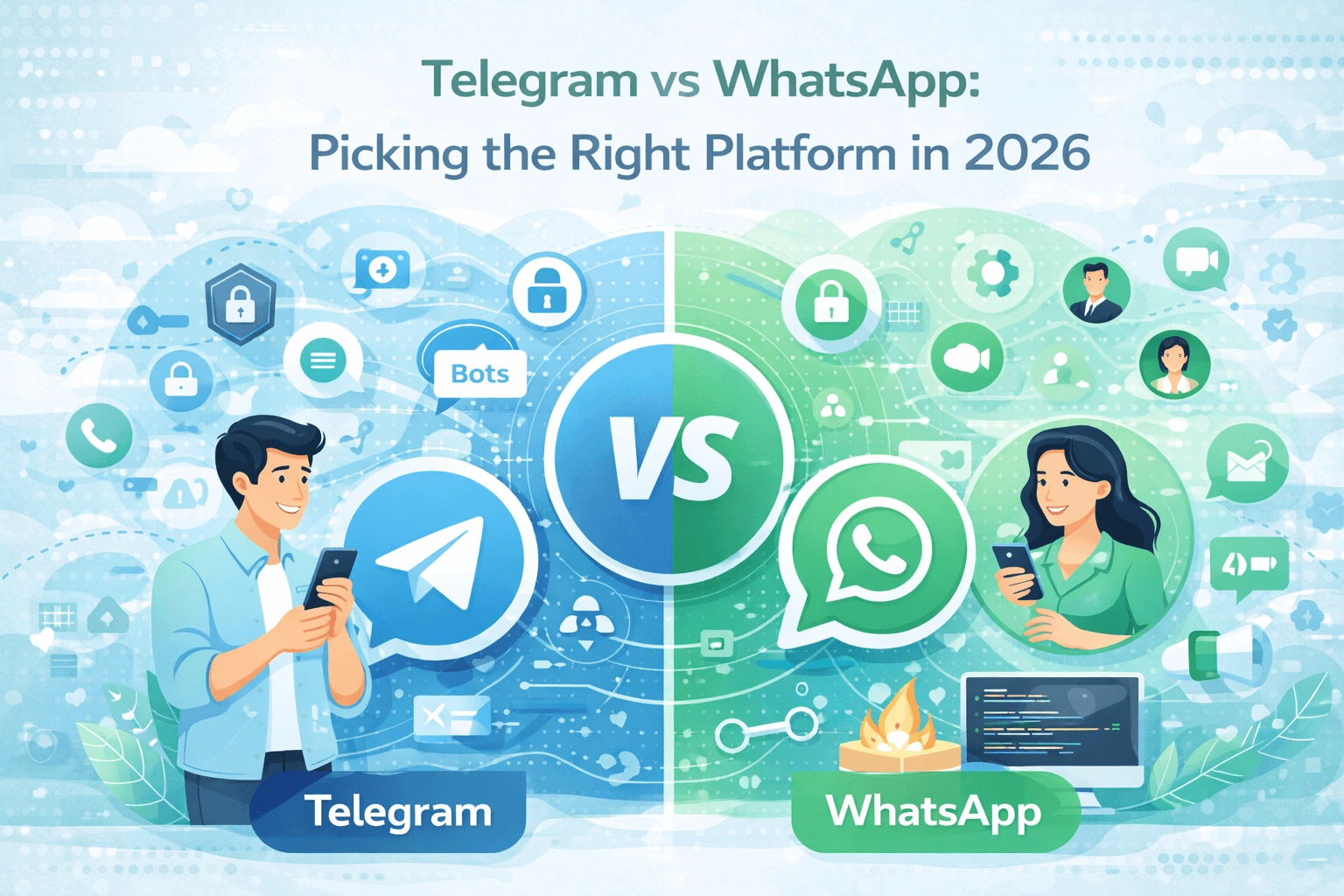
Two platforms.
Two very different philosophies. One critical decision for your business.
WhatsApp and
Telegram are the world's most powerful messaging apps — and in 2026, both are
being used aggressively for marketing, customer communication, community
building, and lead generation. But they are not interchangeable. The platform
that works brilliantly for one business can be the wrong choice for another,
depending on your audience, your goals, and your geography.
This guide gives you a complete, honest, feature-by-feature comparison of Telegram vs. WhatsApp — so you can make the right platform decision for your audience and build a messaging strategy that actually delivers results.
|
3 Billion+ WhatsApp Monthly Active Users |
950 Million+ Telegram Monthly Active Users |
180+ Countries Where WhatsApp is the #1 App |
|
98% WhatsApp Average Message Open Rate |
200,000 Max Telegram Supergroup Members |
Unlimited Telegram Channel Subscribers |
1. Why Choosing the Right Messaging Platform
Matters in 2026
The Rise of Conversational Marketing
The era of
one-way marketing is over. In 2026, consumers expect to interact with brands
the same way they interact with friends — through fast, personal, two-way
conversations. Messaging platforms have become the primary arena for this
shift, replacing email newsletters, static web forms, and even phone calls for
a growing proportion of business communication.
Choosing the
wrong platform means your messages go to audiences who are not there, using
tools that do not fit your workflow, and spending money on infrastructure your
business does not need. Choosing the right platform means meeting your audience
exactly where they already spend their time — and converting those
conversations into customers.
How Platform Choice Impacts Reach, Engagement, and Revenue
The platform you choose determines your potential audience size in specific markets, the type of content you can send, how much automation you can implement, your compliance obligations, the cost of your messaging infrastructure, and the depth of your CRM and analytics integration. Get it right and your messaging channel becomes one of your highest-ROI marketing assets. Get it wrong and you burn budget on a channel your audience ignores.
2. Telegram vs. WhatsApp — A Quick Overview
What Is WhatsApp and Who Uses It?
WhatsApp was
founded in 2009 and acquired by Facebook (now Meta) in 2014. Today it is the
world's most widely used messaging application, with over 3 billion monthly
active users across more than 180 countries. It is the dominant messaging
platform in India, Brazil, most of Europe, the Middle East, and Africa — making
it the essential channel for businesses with international audiences in those
regions.
WhatsApp is
built around personal, one-to-one communication — it feels intimate and
trustworthy to users, which is exactly why businesses get such high open and
response rates when they use it correctly. The WhatsApp Business App serves
smaller businesses, while the WhatsApp Business API powers enterprise-grade
automation, chatbots, and CRM integration.
What Is Telegram and Who Uses It?
Telegram was
launched in 2013 by Pavel Durov and has grown into a powerful platform for
communities, content creators, developers, and privacy-conscious users. With
over 950 million monthly active users globally, Telegram has built its
reputation on speed, security, and features that go far beyond basic messaging
— including channels with unlimited subscribers, supergroups of up to 200,000
members, a powerful native Bot API, and unlimited cloud storage.
Telegram's user
base skews younger and more tech-savvy. It is particularly strong in Eastern
Europe, Russia, Iran, Southeast Asia, and crypto or fintech communities
globally. It is the platform of choice for creators and brands who want to
build large, engaged communities without paying for reach.
Key Numbers: User Base and Global Reach
3. Feature-by-Feature Comparison: Telegram
vs. WhatsApp
Full Feature Comparison Table
|
Feature |
WhatsApp |
Telegram |
|
Monthly
Active Users |
3 Billion+ |
950 Million+ |
|
End-to-End
Encryption |
All chats
(default) |
Secret Chats
only |
|
Group
Member Limit |
1,024 members |
200,000
members |
|
Broadcast
/ Channels |
Broadcast
Lists (limited) |
Unlimited
subscriber channels |
|
Bots &
Automation |
Via API +
BSPs (paid) |
Native Bot
API (free) |
|
File Size
Limit |
2GB per file |
2GB per file |
|
Business
API |
Yes —
WhatsApp Business API |
No official
business API |
|
Ad
Integration |
Click-to-WhatsApp
(Meta Ads) |
Sponsored
Messages (channels) |
|
Multi-Device
Support |
Up to 4
linked devices |
Unlimited
devices |
|
Message
Scheduling |
Third-party
tools only |
Yes — native
feature |
|
Disappearing
Messages |
Yes |
Yes |
|
Cloud
Storage |
Limited |
Unlimited |
|
Cost to
Business |
Free app /
API is paid |
Mostly free |
|
CRM
Integration |
Yes — via API
+ BSPs |
Limited /
custom-built only |
Messaging and Media Capabilities
Both platforms
support text, images, video, audio, documents, and stickers. WhatsApp excels at
voice notes, which have become a primary communication format in many markets.
Telegram offers more advanced media options including GIFs with a dedicated
search engine, native polls, quizzes, and the ability to create custom sticker
packs easily. Telegram also allows message editing for an unlimited time after
sending, while WhatsApp limits editing to a 15-minute window.
Group and Community Features
This is where
the platforms diverge dramatically. WhatsApp groups cap at 1,024 members —
suitable for team chats, customer support groups, or small communities, but
limiting for large-scale community building. Telegram supergroups support up to
200,000 members with advanced moderation tools, topic threading, polls, and
admin permissions. For businesses building large communities or networks,
Telegram is the clear winner on scale.
Bots and Automation
Telegram's native Bot API is one of its most powerful differentiators. Any developer can build and deploy a Telegram bot for free — handling customer enquiries, delivering content, running quizzes, processing payments, and more. WhatsApp automation requires the Business API (which has usage costs) and a third-party BSP or developer setup. For businesses with development resources and a need for free automation, Telegram bots offer significant cost advantages.
4. WhatsApp for Business — Strengths and
Limitations
WhatsApp Business App vs. WhatsApp Business API
The WhatsApp
Business App is a free tool for small businesses, offering a business profile,
catalogue, quick replies, labels, and basic broadcast lists. The WhatsApp
Business API is an enterprise-grade platform that enables automation, chatbots,
CRM integration, multi-agent team inboxes, and programmatic messaging at scale
— with usage-based costs through Meta or third-party Business Solution
Providers.
Best Use Cases for WhatsApp in Business
•
Direct customer support and
sales conversations — high intent, personal, fast
•
Transactional messaging —
order confirmations, appointment reminders, shipping updates
•
Lead generation via
Click-to-WhatsApp ads on Facebook and Instagram
•
Re-engagement campaigns
targeting existing opted-in customers
•
Markets where WhatsApp is
the dominant platform — India, Brazil, Middle East, Europe
•
Businesses requiring CRM
integration and formal analytics reporting
WhatsApp's Limitations You Need to Know
•
Business-initiated messages
require pre-approved templates — no free-form outbound messaging
•
Tier-based daily message
limits (1,000 to unlimited depending on quality and volume)
•
API access has usage costs
— not free for large-scale sending
•
Group size capped at 1,024
members — not suitable for large community building
•
No native message
scheduling — requires third-party tools or API integration
• Owned by Meta — some privacy-conscious audiences are reluctant to use it
5. Telegram for Business — Strengths and
Limitations
Telegram Channels, Groups, and Bots Explained
Telegram offers
three distinct business-relevant structures. Channels are one-way broadcast
tools with unlimited subscribers — perfect for content distribution, news,
updates, and brand announcements. Supergroups are two-way community spaces
supporting up to 200,000 members with advanced moderation. Bots are automated
accounts powered by the free Telegram Bot API, capable of handling everything
from customer service and lead capture to payments and games.
Best Use Cases for Telegram in Business
•
Building large, engaged
communities around your brand, product, or niche
•
Content creators and media
brands distributing news, updates, or exclusive content
•
Crypto, fintech, and tech
companies whose audiences are predominantly on Telegram
•
Businesses in Eastern
Europe, Russia, Iran, or Southeast Asia where Telegram dominates
•
Privacy-first brands whose
audiences distrust Meta-owned platforms
•
Developers and technical
communities wanting free bot-powered automation
• Organic reach at scale — no algorithm suppressing your channel content
Telegram's Limitations You Need to Know
•
No official WhatsApp-style
Business API with formal CRM integration support
•
End-to-end encryption is
not on by default — only in Secret Chats
•
Smaller total user base
than WhatsApp — not suitable as primary channel in many regions
•
No Click-to-Telegram ad
format comparable to WhatsApp's Meta Ads integration
•
Monetisation options are
limited — Telegram Ads platform is still maturing
• Less familiar to older demographics and non-tech-savvy audiences
WhatsApp User Demographics by Region and Age
WhatsApp's user
base is truly global and spans all age groups. It is the dominant messaging app
in India (500+ million users), Brazil, Indonesia, Mexico, Germany, Italy,
Spain, and across Africa and the Middle East. Age-wise, WhatsApp is strong
across 18 to 55+ demographics — it is genuinely used by everyone from teenagers
to grandparents in its core markets, making it the most inclusive messaging
platform available to businesses.
Telegram User Demographics and Community Types
Telegram skews
younger — with the strongest engagement among 18 to 35-year-olds. Its user base
is heavily concentrated in technology, cryptocurrency, gaming, media, and
political communities. It is the dominant platform in Russia and several
post-Soviet states, and has seen massive growth in Iran, the Philippines, and
Brazil. Telegram users tend to be more digitally sophisticated and
privacy-aware than average messaging app users.
Matching Platform to Your Target Audience
End-to-End Encryption — What Each Platform Offers
WhatsApp
applies end-to-end encryption to all messages by default — meaning no one, not
even Meta, can read the content of your messages in transit. This encryption
applies to personal chats, group chats, and calls. Telegram uses a different
approach: standard chats are encrypted in transit and stored on Telegram's
cloud servers (encrypted but accessible to Telegram), while Secret Chats use
full end-to-end encryption that leaves no trace on servers.
Data Collection and Meta's Role in WhatsApp
WhatsApp's
encryption protects message content, but Meta collects significant metadata —
including who you message, when, how often, your location, device information,
and usage patterns. This data can be used for ad targeting across Meta's
platforms. For privacy-conscious users and businesses handling sensitive
information, this metadata collection is a genuine concern. Telegram collects
less metadata by comparison, though it is not entirely free of data collection
either.
Which Platform Is Safer for Sensitive Communications?
For message content security, both platforms offer strong protections when used correctly — WhatsApp by default, Telegram in Secret Chat mode. For metadata privacy, Telegram has a meaningful advantage. For businesses handling sensitive client communications, financial data, or operating in regulated industries, the choice of platform should be guided by a proper privacy assessment and potentially legal advice.
8. Marketing Potential: Which Platform Wins
for Business Growth?
WhatsApp Marketing — Click-to-WhatsApp Ads, Broadcasts, and API Power
WhatsApp offers
the most mature and powerful marketing infrastructure of any messaging platform
in 2026. Click-to-WhatsApp ads on Facebook and Instagram drive warm,
high-intent traffic directly into WhatsApp conversations. The Business API
enables automated chatbots, drip campaigns, and personalised messaging at
scale. CRM integration means every conversation is tracked, scored, and
attributed to revenue. For conversion-focused marketing with strong
measurement, WhatsApp is the superior tool.
Telegram Marketing — Channels, Bots, and Viral Growth Potential
Telegram's
marketing power is different in nature — it is fundamentally about organic
reach and community. A well-run Telegram channel can grow to tens or hundreds
of thousands of subscribers entirely through word-of-mouth and content quality,
with no algorithm suppressing your reach. Every subscriber sees every post.
Bot-powered automation is free and highly customisable. Cross-promotion between
Telegram channels can drive explosive viral growth within niche communities in
ways that are extremely difficult to replicate on WhatsApp.
Cost Comparison: Free Organic Reach vs. Paid API Costs
Telegram is largely free — you can build a channel with 100,000 subscribers and message all of them at zero cost. WhatsApp's Business API involves per-conversation charges, BSP fees, and potentially significant monthly costs at scale. However, WhatsApp's superior conversion rates, CRM integration, and ad ecosystem often deliver stronger ROI on a cost-per-acquisition basis, even with higher infrastructure costs. The right choice depends on your budget, audience, and goals.
9. Should You Use Both Telegram and
WhatsApp?
Running a Dual-Platform Strategy
Many of the
most successful businesses in 2026 do not choose between Telegram and WhatsApp
— they use both, strategically. The two platforms serve different functions in
the customer journey. Telegram excels at top-of-funnel community building,
content distribution, and brand awareness among tech-savvy audiences. WhatsApp
excels at mid-to-bottom-funnel conversion, personalised customer support, and
transactional messaging for your broadest possible audience.
A practical
dual-platform strategy might look like this:
1.
Build a Telegram channel
for content, industry news, and community engagement
2.
Use Telegram bots for free
top-of-funnel lead capture and FAQs
3.
Qualify interested leads
and invite them into WhatsApp for personalised conversations
4.
Run Click-to-WhatsApp ads
targeting warm audiences from both platforms
5.
Use WhatsApp API for
automated follow-up, nurturing, and conversion sequences
6. Maintain Telegram as your community hub and WhatsApp as your conversion engine
How to Decide Which to Prioritise First
If you can only start with one platform, use these questions to decide: Is your target audience primarily in India, Brazil, the Middle East, or Western Europe? Start with WhatsApp. Is your audience tech-savvy, younger, in Eastern Europe or crypto-adjacent communities? Start with Telegram. Do you need formal CRM integration, analytics, and compliance features? WhatsApp. Do you need free, large-scale community building with no budget? Telegram. Is your primary goal direct sales and customer support conversations? WhatsApp. Is your primary goal content distribution and community building? Telegram.
10. Final Verdict — Platform Scorecard by
Use Case
|
Use Case |
WhatsApp |
Telegram |
|
Direct
Customer Support |
✅ Excellent |
⚡ Good |
|
Large
Community Building |
⚡ Limited
(1,024 cap) |
✅ Excellent
(200K+) |
|
Sales
& Conversion |
✅ Excellent |
⚡ Moderate |
|
Content
Broadcasting |
⚡ Limited |
✅ Excellent |
|
Free
Automation (Bots) |
❌ Requires
paid API |
✅ Free native
Bot API |
|
CRM
Integration |
✅ Excellent |
⚡ Limited |
|
Ad
Platform Integration |
✅ Meta Ads
(Click-to-WA) |
⚡ Sponsored
Msgs only |
|
Privacy
& Encryption |
✅ Default E2E
all chats |
⚡ E2E in
Secret Chats only |
|
Global
Reach |
✅ 180+
countries dominant |
⚡ Strong in
specific regions |
|
Cost for
Businesses |
⚡ API has
usage costs |
✅ Mostly free |
Frequently Asked Questions (FAQ)
Optimised for featured snippet ranking and voice search targeting.
Q: Is Telegram better
than WhatsApp for business?
A: It depends on your goals and audience. WhatsApp is
better for direct customer communication, sales conversion, and markets where
it dominates such as India, Brazil, and the Middle East. Telegram is better for
building large communities, broadcasting content for free, and reaching
tech-savvy or privacy-conscious audiences. Many businesses benefit from using
both.
Q: What is the main
difference between Telegram and WhatsApp?
A: The key differences are scale, privacy defaults, and
business tooling. WhatsApp encrypts all messages end-to-end by default and
offers a formal Business API with CRM integration. Telegram encrypts regular
chats server-side (only Secret Chats are end-to-end encrypted) but supports
groups of up to 200,000 members, unlimited broadcast channels, and a free
native Bot API.
Q: Which is safer —
Telegram or WhatsApp?
A: WhatsApp encrypts all messages end-to-end by default,
meaning not even Meta can read them in transit. Telegram only applies
end-to-end encryption in Secret Chats — standard chats are stored on Telegram's
cloud servers. However, Telegram collects less user metadata than WhatsApp. For
most users, WhatsApp offers stronger default message privacy while Telegram
offers better metadata privacy.
Q: Can I use both
Telegram and WhatsApp for my business?
A: Absolutely — and many successful businesses do. A
common dual-platform strategy uses Telegram for top-of-funnel community
building and content broadcasting (free, high reach) and WhatsApp for
mid-to-bottom-funnel sales conversations, customer support, and automated
follow-up sequences (paid but higher conversion).
Q: Which platform has
more users — Telegram or WhatsApp?
A: WhatsApp is significantly larger with over 3 billion
monthly active users globally, making it the world's most widely used messaging
app. Telegram has over 950 million monthly active users. While smaller in total
numbers, Telegram's user base tends to be highly engaged, younger, and more
tech-savvy.
Q: Is Telegram free for
businesses?
A: Yes, Telegram is largely free for businesses. You can
create channels with unlimited subscribers, supergroups with up to 200,000
members, and bots using the free Bot API — all at no cost. Unlike WhatsApp,
there is no paid Business API, which reduces costs but also limits
enterprise-grade features like formal CRM integration.
Q: Which platform is
better for marketing in 2026?
A: WhatsApp offers superior marketing infrastructure through Click-to-WhatsApp ads, the Business API, chatbot automation, and CRM integration — making it stronger for conversion-focused marketing with measurable ROI. Telegram excels at organic community growth, free content broadcasting, and reaching niche audiences without paid infrastructure. The best choice depends on your audience, budget, and primary marketing objective.
Conclusion: The Right Platform Is the One
Your Audience Is Already On
There is no
universal winner in the Telegram vs. WhatsApp debate. Both platforms are
genuinely powerful — and the businesses that will win in 2026 are the ones that
understand the strengths of each, match platform to audience, and build
intentional strategies rather than defaulting to whatever is most familiar.
If your
customers are in India, Brazil, the Middle East, or Western Europe — and you
need a conversion-focused, CRM-integrated messaging channel — WhatsApp is your
primary platform. If your audience is younger, tech-forward, or concentrated in
Eastern Europe or crypto communities — and you need to build a large, engaged
community for free — Telegram is your strategic advantage. And if you have the
capacity to run both, you have one of the most powerful dual-channel
communication strategies available in digital marketing today.
The messaging revolution is not slowing down. Start with clarity on your audience, commit to the right platform, and build a channel that your customers genuinely want to be part of.