Jun 24, 2026
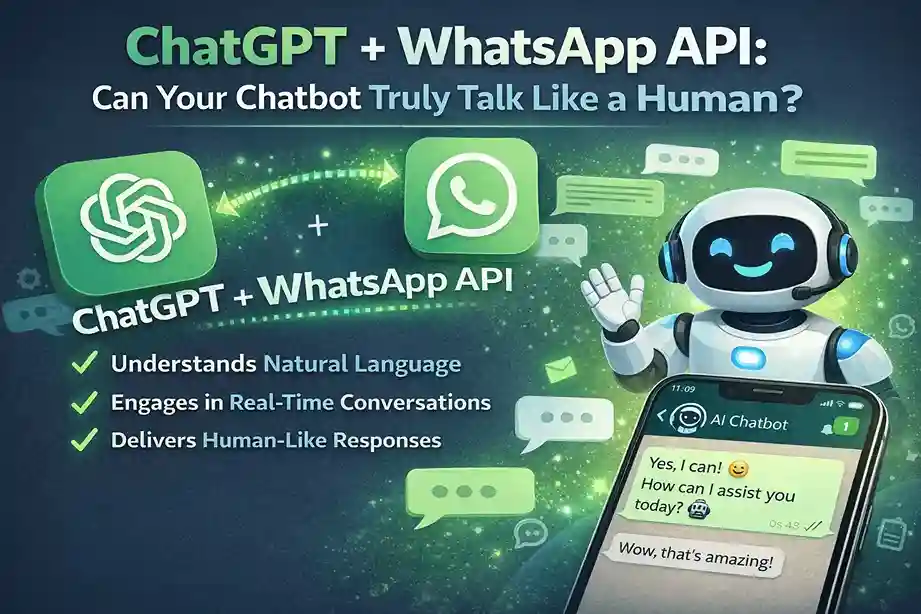
Discover how ChatGPT WhatsApp API integration enables chatbots that truly talk like a human. Explore real use cases, setup steps, and why NXC Controls WABA is India's top AI chatbot platform.
The Problem
The Problem with Traditional WhatsApp Chatbots in India
By 2026, over 80% of Indian businesses are expected to use WhatsApp automation for at least one customer-facing process. But there is a vast difference between automating WhatsApp and doing it well — and millions of customers across India know this difference from frustrating experience.
Most WhatsApp "chatbots" deployed by Indian businesses today are decision trees — numbered menus that force customers into rigid paths. Press 1 for orders. Press 2 for returns. Press 3 for... The customer's question doesn't fit any option. They press 0 for "agent." The agent is offline. They leave.
This is not a chatbot problem. It is a technology choice problem. Rule-based menu bots are not AI. They cannot understand a natural language question they have not seen before. They cannot handle a conversation where the customer asks two things in one message. They cannot respond in Hinglish, remember context from three messages ago, or give a specific answer about your product without a human writing every possible response in advance.
📊
The Indian customer expectation gap in 2026
Indian customers now message businesses at all hours — 535 million WhatsApp users, many of them sending support queries at 10pm, 11pm, or 2am. They expect a reply within minutes. They expect to be understood the first time. They switch to a competitor the moment they feel like they are talking to a machine. The businesses winning on WhatsApp in 2026 have closed this gap with genuine AI — not numbered menus.
💬
Not yet on WhatsApp Business API?Read: How to Set Up WhatsApp Business API India — Complete 2026 Guide →
The Technology
How ChatGPT + WhatsApp API Actually Works
The phrase "ChatGPT + WhatsApp API" captures two technologies working together — but the most important part of making it work for your business is a third component that most people miss: your own business data.
ChatGPT (and large language models like Groq AI) are trained on billions of pages of human text. They understand language fluently — grammar, context, tone, intent, nuance. What they do not know, out of the box, is anything specific about your business. Ask generic ChatGPT "What is the return policy for Order #ORD-55231?" and it will tell you how return policies generally work — not your policy, not your order.
The breakthrough that makes AI chatbots genuinely useful for Indian businesses is connecting the language model to your specific knowledge — your product catalogue, your FAQs, your shipping terms, your pricing, your inventory. This is called a knowledge base — and it is what transforms a general-purpose AI into a smart business assistant that knows exactly what to say to your customers.
🧠
How NXCMSG WABA's Groq AI knowledge base works
Upload your business documents — product FAQ PDF, return policy, size guide, service list, pricing sheet. The Groq AI reads and indexes everything. When a customer asks a question on WhatsApp, the AI searches your knowledge base, finds the relevant answer, and generates a natural, accurate, on-brand response — in seconds, 24 hours a day. It does not hallucinate answers it doesn't know. It escalates gracefully to a human agent when the query exceeds its knowledge boundary.
What a Human-Like AI Conversation Actually Looks Like
💬 Real AI WhatsApp Conversation — Powered by NXCMSG WABA
Customer · 2:14am
Hi, I ordered the black kurta in M but I think I need L. Can I exchange it? Also do you have it in dark green?
🤖 NXCMSG AI Assistant
Hi! Yes, you can exchange your order for a larger size — exchanges are free within 7 days of delivery. 😊
The black kurta is available in L — I can raise the exchange request right now if you'd like.
Regarding dark green — we currently have the same style in Forest Green (very similar shade!) in sizes S to XL. Want me to check if L is in stock for that too?
The black kurta is available in L — I can raise the exchange request right now if you'd like.
Regarding dark green — we currently have the same style in Forest Green (very similar shade!) in sizes S to XL. Want me to check if L is in stock for that too?
Customer · 2:15am
Yes please check both — and how long does the exchange take?
🤖 NXCMSG AI Assistant
Great news — L is available in both Black and Forest Green! ✅
Exchange timeline: pickup in 2–3 days, delivery of new item in 5–7 days from pickup.
Which colour would you like to exchange to — Black L or Forest Green L? I'll raise the request immediately.
Exchange timeline: pickup in 2–3 days, delivery of new item in 5–7 days from pickup.
Which colour would you like to exchange to — Black L or Forest Green L? I'll raise the request immediately.
This entire conversation happened at 2:14am — with no human agent involved, no waiting, and a customer whose multi-part query was understood and fully resolved in two exchanges. This is what genuine AI on WhatsApp delivers.
What "Human-Like" Really Means
5 Qualities That Make an AI Chatbot Feel Truly Human
Not all AI chatbots feel the same. The difference between a chatbot customers trust and one they abandon within two messages comes down to five specific qualities — and NXCMSG WABA's Groq AI delivers all five.
01
Contextual Memory — It Remembers What You Just Said
A human support agent remembers that you said "my order number is ORD-55231" three messages ago and applies that context to every answer. Most chatbots forget instantly — asking for the same information again every reply. NXCMSG WABA's AI maintains full conversation context throughout the session, so customers never have to repeat themselves. This single quality changes the entire feel of the interaction from robotic to natural.
🧠 NXCMSG WABA: Full conversation context maintained throughout02
Multi-Intent Understanding — One Message, Multiple Questions
Customers do not communicate in neat, single-question formats. Real messages are: "Can I change my address AND is my order still on time AND do you have express delivery?" A traditional chatbot handles one intent per message. NXCMSG WABA's Groq AI parses all three questions simultaneously and answers each accurately in a single coherent response — exactly the way a skilled human agent would.
💬 Handles multi-intent queries in one natural response03
Your Business Knowledge — Not Generic Answers
Generic ChatGPT knows about the world — not your business. An AI chatbot that gives generic answers about how returns "usually work" while failing to answer your specific 7-day free return policy destroys customer trust instantly. NXCMSG WABA trains the AI on your documents — so every answer is specific, accurate, and on-brand. Customers get your actual policy, your actual prices, your actual stock levels — not a general guess.
📄 Trained on your documents — specific, accurate, on-brand always04
Indian Language Fluency — Hindi, Hinglish & Regional Languages
A chatbot that only responds in formal English feels foreign to millions of Indian customers who write in Hindi, Hinglish (Hindi + English mixed), Gujarati, Tamil, or Telugu. NXCMSG WABA's AI chatbot supports 10 Indian languages — detecting the customer's language automatically and responding in kind. A customer who writes "bhaiya mera order kab aayega" gets a reply in the same natural tone — not a robotic formal English redirect.
🌐 10 Indian languages including Hinglish — auto-detected05
Graceful Escalation — Knowing When to Hand Over to a Human
The most human-like quality of a great AI chatbot is knowing its own limits. When a customer's query goes beyond the AI's knowledge, or when the customer explicitly asks for a human, or when sentiment analysis detects frustration — NXCMSG WABA's AI hands over to a live agent in the shared team inbox with the full conversation history visible. The agent has complete context before typing a single word. No customer explains their issue twice.
🤝 Seamless human handover with full context — no repetitionReal Business Impact
Real Use Cases — AI Chatbot on WhatsApp for Indian Businesses
Across every Indian industry, WhatsApp chatbot for customer support India is moving from experimental to essential. These are the highest-impact use cases delivering measurable results right now.
🛒
Ecommerce — Order & Returns on Autopilot
AI handles order status, exchange requests, delivery rescheduling, COD confirmations, and product availability queries — 24/7, without a single agent involved for routine queries.
📉 40–60% support ticket reduction🏠
Real Estate — Lead Qualification at 2am
AI captures lead details, qualifies budget and timeline, answers project FAQs from brochure, and books site visits — converting midnight inquiries from IndiaMart or CTWA ads automatically.
⚡ Instant response to every lead — no delay🎓
EdTech — Student Support Without Staff Overtime
AI answers course queries, fee payment questions, batch schedule requests, and demo booking — in Hindi and English — serving students who study late and message outside business hours.
🌙 24/7 student support without extra headcount🏥
Healthcare — Appointment Booking & Patient FAQs
AI confirms appointment times, answers pre-procedure queries from your medical FAQ, and sends reminder messages with Confirm / Reschedule buttons — reducing no-shows significantly.
📅 Automated booking with zero manual effort🏦
BFSI — Verified Queries Without Call Centre Load
AI answers policy queries, premium due reminders, loan status questions, and basic account balance requests — trained on your financial product documents with full DPDP compliance.
📞 Reduces call centre volume significantly🏭
B2B & Manufacturing — IndiaMart Lead Automation
Every IndiaMart inquiry triggers an instant AI response — product specifications from your catalogue, pricing for common quantities, and automatic qualification before routing to sales.
🔗 Zero cold leads — every inquiry gets instant reply"We had 3 support staff answering the same 15 questions all day — size guide, return policy, delivery timelines, order status. After NXCMSG WABA's AI chatbot, those 15 questions are handled automatically. Our team now only handles genuine escalations — about 30% of what they used to handle. They're more engaged and our customers get faster answers. It was the best thing we did for our business this year."
— NXCMSG WABA Customer, Apparel Brand, Surat70%Of support queries resolved by NXCMSG AI without human intervention
2 minAverage AI response time vs 4+ hours for manual WhatsApp replies
24/7AI always available — including weekends, holidays, and 2am inquiries
Technology Comparison
Rule-Based vs AI Chatbot — The Real Difference
Most Indian businesses that have "tried chatbots and found them useless" were using rule-based menu bots — not AI. The difference is not cosmetic. It is fundamental.
❌ Rule-Based Menu Bot
What most Indian businesses have today
- Fixed numbered menus — Press 1, 2, 3
- Only recognises exact keyword matches
- Fails on any question not pre-programmed
- No context — forgets every message instantly
- Cannot handle multi-intent queries
- English only — no Hindi or regional support
- Frustrates customers — high abandon rate
- Requires rebuilding for every new FAQ
✅ NXCMSG WABA Groq AI Chatbot
What Indian businesses need in 2026
- Natural language — customers type anything
- Understands intent behind any question
- Answers questions it has never seen before
- Full conversation context maintained
- Handles multiple questions per message
- Hindi, Hinglish, Gujarati + 7 more languages
- Customers feel heard — high satisfaction
- Learn by uploading new documents anytime
💡
The Hinglish test — can your chatbot pass it?
Send your current chatbot this message: "bhaiya mera order 3 din se pending hai aur tracking nhi hua abhi tak, kab milega". If it responds with a numbered menu or an English auto-reply that ignores the question — you have a rule-based bot, not an AI. NXCMSG WABA's Groq AI reads Hinglish naturally, understands the frustration in the message, and responds with the specific order status from your system — in the customer's own language and tone.
📋
Need to get WhatsApp templates approved for your chatbot flows?Read: How to Get WhatsApp Template Approved — Step by Step India 2026 →
Platform Deep Dive
NXCMSG WABA — India's Most Complete AI WhatsApp Chatbot Platform
NXCMSG WABA is the only WhatsApp Business API platform in India that combines a Groq-powered AI knowledge base, a full no-code drag-and-drop chatbot builder, bulk opt-in messaging, CRM integration, and unlimited agents — all at ₹3,000/month flat with zero BSP markup.
🧠
NXCMSG WABA — AI-Powered WhatsApp Platform India
32,000+ Indian businesses · waba.nxccontrols.in✦ Groq AI Knowledge Base No-Code · No Developer70%Support queries resolved by AI automatically
24/7AI always on — no off-hours, no weekends
10Indian languages supported including Hindi
🧠
Groq AI Knowledge BaseUpload your docs — AI trained on your exact business information instantly
🤖
No-Code Flow BuilderDrag-and-drop chatbot design — zero coding, zero developer needed
🌐
10 Indian LanguagesHindi, Hinglish, Gujarati, Tamil, Telugu + 5 more — auto-detected
🤝
Seamless Agent HandoverAI escalates with full context — no customer repeats their issue
📢
Bulk Opt-in CampaignsAI chatbot + broadcast campaigns from one unified platform
👥
Unlimited Agent InboxEntire team in one shared dashboard — no per-seat fees
🔗
CRM & API IntegrationZoho, HubSpot, Shopify, webhooks — all included, no extra charge
💰
₹3,000/month FlatZero BSP markup · Zero setup fee · 14-day free trial
What Makes NXCMSG WABA's AI Different from Generic ChatGPT on WhatsApp
🎯
Business-Specific Training
Generic ChatGPT knows nothing about your products, policies, or prices. NXCMSG WABA's AI is trained exclusively on your documents — making every answer accurate and relevant.
Your data · Your answers🔒
No Hallucination Guardrails
The AI never invents answers it doesn't know. When a query exceeds its training, it says so honestly and escalates — protecting your brand from misinformation.
Accurate · Honest · Safe⚡
Groq Speed — Sub-Second Responses
Groq's inference engine is dramatically faster than standard GPT APIs — delivering AI responses in under one second, making conversations feel genuinely real-time.
Instant replies · No lag📋
DPDP Act 2023 Compliant
Customer data handled with full compliance to India's Digital Personal Data Protection Act — opt-in consent, data storage controls, and secure processing built in.
India-compliant · SecureGetting Started
How to Deploy Your AI WhatsApp Chatbot in 5 Steps
From zero to a fully functioning AI WhatsApp chatbot — here is the exact process with NXCMSG WABA. No developer. No complicated setup. Free for the first 14 days.
1
Sign Up Free at waba.nxccontrols.in
Create your account in 5 minutes. No credit card required. No setup fee. The NXCMSG onboarding team reaches out within one business hour to guide your setup personally — by phone or WhatsApp in Hindi or English.
2
Connect Your WhatsApp Business Number
Connect your Meta Business Manager and verify your dedicated business phone number. NXCMSG WABA's team guides you through every step. Most Indian businesses are connected within one business day.
3
Upload Your Business Documents to the AI Knowledge Base
Upload your product FAQ PDF, return policy, size guide, service list, pricing document — whatever describes your business. The Groq AI reads and indexes everything automatically. No tagging, no programming, no labelling required.
4
Build Your Chatbot Flows with the No-Code Builder
Use the drag-and-drop flow builder to design your conversation structure — greeting flow, FAQ routing, lead capture, order status lookup, escalation trigger, and agent handover rules. Visual, intuitive, no code at any step.
5
Go Live — Your AI Chatbot Handles Conversations from Day One
Activate your chatbot. Share your WhatsApp number with customers. Watch the AI handle real conversations in real time from your analytics dashboard. The AI learns from usage and you can update its knowledge base anytime by uploading new documents.
🚀
From signup to first AI conversation — under 24 hours
Most NXCMSG WABA customers have their AI chatbot live and handling real customer conversations within one business day of signing up. The onboarding team's guided setup, the no-code builder, and the document-upload AI training process are designed to get Indian businesses to value as quickly as possible — without requiring any technical expertise from your team.
Give Your Business a Chatbot That Truly Talks Like a Human
Train the AI on your business documents. Deploy in one day. Answer customer questions at 2am while you sleep. Start free — no card, no developer needed.
🚀 Start Free 14-Day Trial on NXCMSG WABA