Jun 24, 2026
Compare AI-powered chatbots vs rule-based bots. Discover which artificial intelligence powered solution drives better results, lower costs, and higher customer satisfaction for your business.
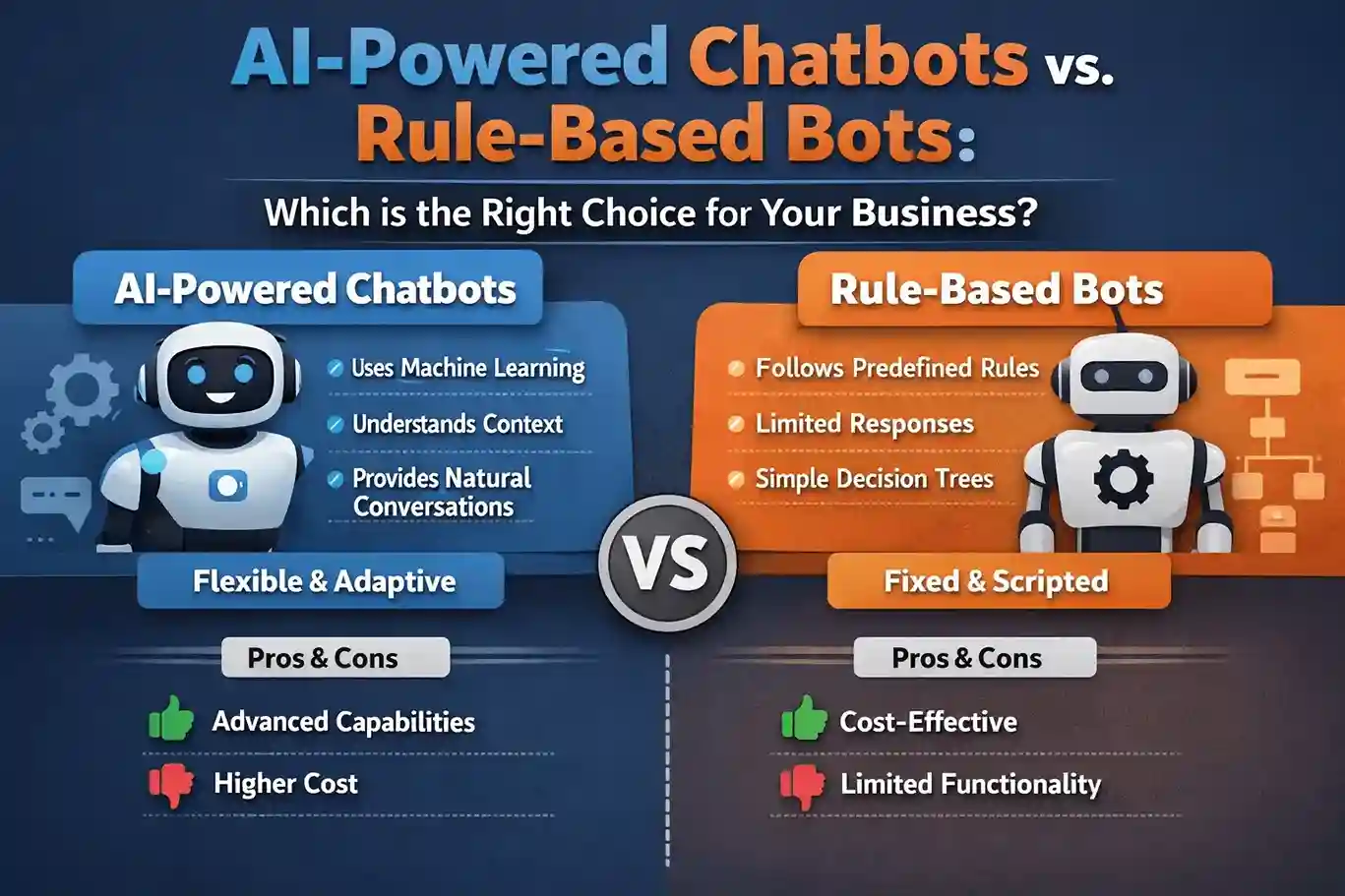
In the past five years, chatbots have gone
from a novelty to an operational necessity. Businesses of every size — from
local retailers to global enterprises — are deploying automated conversation
tools to handle customer queries, drive sales, and reduce overhead costs. But
not all chatbots are created equal.
At the centre of today's automation debate
sits a fundamental question: should your business use an AI-powered chatbot or a rule-based bot? The answer can have a profound
impact on your customer experience, operational efficiency, and ultimately,
your bottom line.
This comprehensive guide breaks down every
aspect of both technologies — from how they work and what they cost, to which
industries benefit most and how to make the switch. Whether you're evaluating
your first chatbot or looking to upgrade an existing system, this guide gives
you the knowledge to make a confident, informed decision.
According to Gartner, by 2027, chatbots will become the
primary customer service channel for roughly 25% of organizations worldwide.
Businesses that adopt artificial intelligence
powered automation today are positioning themselves ahead of this
curve.
In the past five years, chatbots have gone
from a novelty to an operational necessity. Businesses of every size — from
local retailers to global enterprises — are deploying automated conversation
tools to handle customer queries, drive sales, and reduce overhead costs. But
not all chatbots are created equal.
At the centre of today's automation debate
sits a fundamental question: should your business use an AI-powered chatbot or a rule-based bot? The answer can have a profound
impact on your customer experience, operational efficiency, and ultimately,
your bottom line.
This comprehensive guide breaks down every
aspect of both technologies — from how they work and what they cost, to which
industries benefit most and how to make the switch. Whether you're evaluating
your first chatbot or looking to upgrade an existing system, this guide gives
you the knowledge to make a confident, informed decision.
According to Gartner, by 2027, chatbots will become the primary customer service channel for roughly 25% of organizations worldwide. Businesses that adopt artificial intelligence powered automation today are positioning themselves ahead of this curve.
Section 2: What is a Rule-Based Chatbot?
A rule-based
chatbot — also called a decision-tree bot or scripted bot — operates
entirely on a predefined set of logical rules. Think of it as an advanced
"If This, Then That" engine: if the user types a specific keyword or
selects a specific button, the bot returns a pre-written response.
There is no intelligence involved. The bot
does not understand language. It simply pattern-matches input against a list of
rules that a human developer programmed in advance. If a user's message falls
outside those rules, the bot fails.
A rule-based
chatbot — also called a decision-tree bot or scripted bot — operates
entirely on a predefined set of logical rules. Think of it as an advanced
"If This, Then That" engine: if the user types a specific keyword or
selects a specific button, the bot returns a pre-written response.
There is no intelligence involved. The bot
does not understand language. It simply pattern-matches input against a list of
rules that a human developer programmed in advance. If a user's message falls
outside those rules, the bot fails.
2.1 — How Rule-Based Bots Work
•
Trigger Detection: The
bot scans user input for pre-set keywords or exact phrases
•
Decision Tree Navigation: The
matched trigger routes the user down a predefined conversation path
•
Static Response Delivery: A
fixed, pre-written answer is returned — no variation possible
•
Fallback or Loop: If
no match is found, the bot either loops back or shows an error message
•
Trigger Detection: The
bot scans user input for pre-set keywords or exact phrases
•
Decision Tree Navigation: The
matched trigger routes the user down a predefined conversation path
•
Static Response Delivery: A
fixed, pre-written answer is returned — no variation possible
•
Fallback or Loop: If
no match is found, the bot either loops back or shows an error message
2.2 — Common Use Cases for Rule-Based Bots
•
Simple FAQ pages ("What are your business
hours?")
•
Basic appointment booking with fixed time slots
•
Menu-driven navigation ("Press 1 for Sales, Press
2 for Support")
•
Simple lead capture forms converted to chat format
•
Single-step transactions with no conditional logic
•
Simple FAQ pages ("What are your business
hours?")
•
Basic appointment booking with fixed time slots
•
Menu-driven navigation ("Press 1 for Sales, Press
2 for Support")
•
Simple lead capture forms converted to chat format
•
Single-step transactions with no conditional logic
2.3 — Strengths of Rule-Based Bots
•
Fast and cheap to build for very simple, predictable
interactions
•
Zero AI training required — ready to deploy quickly
•
Predictable, consistent output for narrow use cases
•
Easy for non-technical teams to understand and audit
•
Fast and cheap to build for very simple, predictable
interactions
•
Zero AI training required — ready to deploy quickly
•
Predictable, consistent output for narrow use cases
•
Easy for non-technical teams to understand and audit
2.4 — Critical Weaknesses of Rule-Based Bots
•
Cannot understand natural language variations, typos,
or context
•
Every new scenario requires manual developer
intervention
•
Creates user frustration when queries fall outside the
script
•
Cannot learn or improve — static forever unless
manually updated
•
Fails completely with multi-intent queries ("I
want to order AND check my old order")
•
Cannot personalize responses — every user gets the same
answer
•
Cannot understand natural language variations, typos,
or context
•
Every new scenario requires manual developer
intervention
•
Creates user frustration when queries fall outside the
script
•
Cannot learn or improve — static forever unless
manually updated
•
Fails completely with multi-intent queries ("I
want to order AND check my old order")
• Cannot personalize responses — every user gets the same answer
Section 3: What is an AI-Powered Chatbot?
An AI-powered
chatbot uses Natural Language
Processing (NLP), Machine Learning (ML),
and sometimes Large Language Models (LLMs)
to understand, interpret, and respond to user messages in a dynamic,
context-aware way. Unlike rule-based bots, an artificial
intelligence powered chatbot understands the intent behind a message — not just the literal
words.
This means that even if a user types
"whr r my ordrs" instead of "Where is my order?", an AI-powered chatbot correctly identifies the
intent and responds accurately. It carries context across multiple messages,
adapts to the user's tone, and continuously improves through machine learning.
An AI-powered
chatbot uses Natural Language
Processing (NLP), Machine Learning (ML),
and sometimes Large Language Models (LLMs)
to understand, interpret, and respond to user messages in a dynamic,
context-aware way. Unlike rule-based bots, an artificial
intelligence powered chatbot understands the intent behind a message — not just the literal
words.
This means that even if a user types
"whr r my ordrs" instead of "Where is my order?", an AI-powered chatbot correctly identifies the
intent and responds accurately. It carries context across multiple messages,
adapts to the user's tone, and continuously improves through machine learning.
3.1 — Core Technologies Behind AI-Powered Chatbots
•
NLP (Natural Language
Processing): Enables the bot to understand human language as spoken
or typed, including slang, spelling errors, and regional variations
•
Intent Recognition: Identifies
what the user wants to achieve, even if expressed in multiple different ways
•
Entity Extraction: Pulls
key data points from the message — dates, names, product IDs, locations
•
Contextual Memory: Remembers
earlier parts of the conversation to maintain coherent multi-turn dialogue
•
Sentiment Analysis: Detects
user emotion (frustration, satisfaction, urgency) to adapt tone and escalate
when necessary
•
Machine Learning: The
bot improves continuously from real conversation data, getting smarter with
every interaction
•
NLP (Natural Language
Processing): Enables the bot to understand human language as spoken
or typed, including slang, spelling errors, and regional variations
•
Intent Recognition: Identifies
what the user wants to achieve, even if expressed in multiple different ways
•
Entity Extraction: Pulls
key data points from the message — dates, names, product IDs, locations
•
Contextual Memory: Remembers
earlier parts of the conversation to maintain coherent multi-turn dialogue
•
Sentiment Analysis: Detects
user emotion (frustration, satisfaction, urgency) to adapt tone and escalate
when necessary
•
Machine Learning: The
bot improves continuously from real conversation data, getting smarter with
every interaction
3.2 — The Role of Powered AI in Modern Chatbots
Today's most advanced chatbots are powered AI systems built on transformer
architectures similar to GPT, BERT, or proprietary enterprise NLP engines.
These systems go far beyond keyword matching — they understand nuance, handle
ambiguity, support multi-lingual conversations, and can even take autonomous
actions like placing orders, processing refunds, or updating CRM records in
real time.
Today's most advanced chatbots are powered AI systems built on transformer
architectures similar to GPT, BERT, or proprietary enterprise NLP engines.
These systems go far beyond keyword matching — they understand nuance, handle
ambiguity, support multi-lingual conversations, and can even take autonomous
actions like placing orders, processing refunds, or updating CRM records in
real time.
3.3 — Types of AI-Powered Chatbots
Feature
AI-Powered
Chatbot
Rule-Based
Bot
Type
Technology Used
Best For
NLP Chatbot
Intent classification + Entity extraction
Customer support, lead gen
Generative AI Bot
LLMs (GPT, Claude, Gemini)
Open-ended, creative dialogue
Hybrid Bot
NLP + Rule-based fallbacks
Structured but flexible flows
Transactional Bot
AI + API integrations
Orders, payments, bookings
💡
NXC Controls Advantage: The WABA AI-Powered Chatbot Platform by NXC
Controls combines NLP intent recognition with deep WhatsApp Business API
integration — giving your business a fully powered AI experience on
the world's most popular messaging platform.
|
Feature |
AI-Powered
Chatbot |
Rule-Based
Bot |
|
Type |
Technology Used |
Best For |
|
NLP Chatbot |
Intent classification + Entity extraction |
Customer support, lead gen |
|
Generative AI Bot |
LLMs (GPT, Claude, Gemini) |
Open-ended, creative dialogue |
|
Hybrid Bot |
NLP + Rule-based fallbacks |
Structured but flexible flows |
|
Transactional Bot |
AI + API integrations |
Orders, payments, bookings |
|
💡
NXC Controls Advantage: The WABA AI-Powered Chatbot Platform by NXC
Controls combines NLP intent recognition with deep WhatsApp Business API
integration — giving your business a fully powered AI experience on
the world's most popular messaging platform. |
Section 4:
Head-to-Head Feature Comparison
Below is a comprehensive comparison of AI-powered chatbots vs. rule-based bots across every dimension that
matters for a business deployment:
Feature
AI-Powered
Chatbot
Rule-Based
Bot
Language Understanding
NLP — understands intent & context
Keyword/command matching only
Handles Typos & Slang
Yes — robust NLU engine
No — exact match required
Multi-Turn Conversations
Yes — contextual memory across turns
No — each message is independent
Personalization
Dynamic, user-specific responses
Generic, one-size-fits-all
Learning Ability
Self-improves with ML over time
No self-learning capability
Setup Complexity
Medium-High (training required)
Low (script-based setup)
Maintenance
Low — AI adapts automatically
High — manual updates always needed
Scalability
Unlimited, handles 1000s simultaneously
Limited to predefined script paths
Integration
CRM, ERP, APIs, payments, databases
Basic form data & triggers only
Multi-Language Support
Yes — with multilingual NLP models
Only if manually scripted per language
Sentiment Detection
Yes — adjusts tone, flags urgency
No
Analytics & Insights
Deep — intent analytics, drop-offs, trends
Basic — click counts only
Cost (Upfront)
Medium-High
Low
Cost (Long-Term TCO)
Low — scales without extra cost
High — grows with query volume
Best For
High-volume, varied, complex queries
Simple, linear, predictable flows
Below is a comprehensive comparison of AI-powered chatbots vs. rule-based bots across every dimension that matters for a business deployment:
|
Feature |
AI-Powered
Chatbot |
Rule-Based
Bot |
|
Language Understanding |
NLP — understands intent & context |
Keyword/command matching only |
|
Handles Typos & Slang |
Yes — robust NLU engine |
No — exact match required |
|
Multi-Turn Conversations |
Yes — contextual memory across turns |
No — each message is independent |
|
Personalization |
Dynamic, user-specific responses |
Generic, one-size-fits-all |
|
Learning Ability |
Self-improves with ML over time |
No self-learning capability |
|
Setup Complexity |
Medium-High (training required) |
Low (script-based setup) |
|
Maintenance |
Low — AI adapts automatically |
High — manual updates always needed |
|
Scalability |
Unlimited, handles 1000s simultaneously |
Limited to predefined script paths |
|
Integration |
CRM, ERP, APIs, payments, databases |
Basic form data & triggers only |
|
Multi-Language Support |
Yes — with multilingual NLP models |
Only if manually scripted per language |
|
Sentiment Detection |
Yes — adjusts tone, flags urgency |
No |
|
Analytics & Insights |
Deep — intent analytics, drop-offs, trends |
Basic — click counts only |
|
Cost (Upfront) |
Medium-High |
Low |
|
Cost (Long-Term TCO) |
Low — scales without extra cost |
High — grows with query volume |
|
Best For |
High-volume, varied, complex queries |
Simple, linear, predictable flows |
Section 5: Key Benefits of AI-Powered Chatbots for
Businesses
5.1 —
24/7 Intelligent Support Without Additional Headcount
An AI-powered
chatbot operates around the clock, handling thousands of simultaneous
conversations without fatigue, sick days, or overtime pay. According to IBM,
businesses that deploy AI chatbots reduce customer service costs by up to 30%
within the first year.
Unlike a rule-based bot that fails the
moment a user asks an unexpected question, an artificial
intelligence powered system gracefully handles ambiguous queries,
asks clarifying questions, and resolves issues end-to-end — without any human
agent involvement.
An AI-powered
chatbot operates around the clock, handling thousands of simultaneous
conversations without fatigue, sick days, or overtime pay. According to IBM,
businesses that deploy AI chatbots reduce customer service costs by up to 30%
within the first year.
Unlike a rule-based bot that fails the
moment a user asks an unexpected question, an artificial
intelligence powered system gracefully handles ambiguous queries,
asks clarifying questions, and resolves issues end-to-end — without any human
agent involvement.
5.2 — Higher Customer Satisfaction Scores
Powered AI
technology enables bots to detect the user's sentiment — identifying
frustration, urgency, or confusion — and adapt accordingly. Angry customers get
escalated to humans immediately. Happy customers get upsell offers. This level
of intelligent routing measurably improves CSAT and NPS scores.
•
Faster first response time (instant vs. minutes for
human agents)
•
Context-aware responses that feel human and personal
•
Consistent quality regardless of time of day or agent
availability
•
Proactive engagement — bots can initiate conversations
based on user behaviour
Powered AI
technology enables bots to detect the user's sentiment — identifying
frustration, urgency, or confusion — and adapt accordingly. Angry customers get
escalated to humans immediately. Happy customers get upsell offers. This level
of intelligent routing measurably improves CSAT and NPS scores.
•
Faster first response time (instant vs. minutes for
human agents)
•
Context-aware responses that feel human and personal
•
Consistent quality regardless of time of day or agent
availability
•
Proactive engagement — bots can initiate conversations
based on user behaviour
5.3 — Seamless Omnichannel Deployment
A single AI-powered
NLP engine can simultaneously power your WhatsApp bot, website chat widget,
Instagram DM automation, SMS campaigns, and in-app support — all from one
platform. Rule-based bots require separate scripting for each channel.
A single AI-powered
NLP engine can simultaneously power your WhatsApp bot, website chat widget,
Instagram DM automation, SMS campaigns, and in-app support — all from one
platform. Rule-based bots require separate scripting for each channel.
5.4 — Deep Business System Integration
Artificial
intelligence powered chatbots integrate directly with:
•
CRM systems (Salesforce, HubSpot, Zoho) — for
personalized context
•
ERP systems — for real-time inventory, order status,
and fulfilment data
•
Payment gateways — to collect payments within the chat
window
•
Logistics APIs — for live shipment tracking
•
HR systems — for employee self-service and leave
management
Artificial
intelligence powered chatbots integrate directly with:
•
CRM systems (Salesforce, HubSpot, Zoho) — for
personalized context
•
ERP systems — for real-time inventory, order status,
and fulfilment data
•
Payment gateways — to collect payments within the chat
window
•
Logistics APIs — for live shipment tracking
•
HR systems — for employee self-service and leave
management
5.5 — Lead Generation, Qualification & Sales
Automation
With AI-powered
chatbots, every website visitor or WhatsApp interaction becomes a lead
generation opportunity. The bot qualifies prospects through intelligent
conversation, scores them based on responses, and routes hot leads directly to
your sales team — all in real time.
Platforms like NXC Controls
WABA enable businesses to run complete powered
AI sales funnels entirely within WhatsApp — from initial enquiry to
payment confirmation.
With AI-powered
chatbots, every website visitor or WhatsApp interaction becomes a lead
generation opportunity. The bot qualifies prospects through intelligent
conversation, scores them based on responses, and routes hot leads directly to
your sales team — all in real time.
Platforms like NXC Controls
WABA enable businesses to run complete powered
AI sales funnels entirely within WhatsApp — from initial enquiry to
payment confirmation.
5.6 — Rich Analytics & Continuous Improvement
Every AI-powered
conversation generates valuable data: what users are asking, where they drop
off, which intents are most common, and which responses generate the best
outcomes. Rule-based bots provide only basic click data. AI chatbots provide a
full strategic intelligence layer that helps you optimize both your product and
your marketing.
Every AI-powered conversation generates valuable data: what users are asking, where they drop off, which intents are most common, and which responses generate the best outcomes. Rule-based bots provide only basic click data. AI chatbots provide a full strategic intelligence layer that helps you optimize both your product and your marketing.
Section 6:
Limitations — AI-Powered vs. Rule-Based
6.1 — Limitations of
AI-Powered Chatbots
•
Higher initial setup cost:
NLP training, data collection, and integration work requires upfront
investment
•
Cold start problem: New
AI bots need sufficient training data before performing optimally
•
Requires quality data: Poor
training data leads to inaccurate intent recognition — garbage in, garbage out
•
Occasional hallucinations:
Generative AI bots can produce incorrect responses if not properly
constrained
•
Regulatory compliance: In
highly regulated industries (finance, healthcare), AI responses need additional
governance layers
•
Higher initial setup cost:
NLP training, data collection, and integration work requires upfront
investment
•
Cold start problem: New
AI bots need sufficient training data before performing optimally
•
Requires quality data: Poor
training data leads to inaccurate intent recognition — garbage in, garbage out
•
Occasional hallucinations:
Generative AI bots can produce incorrect responses if not properly
constrained
•
Regulatory compliance: In
highly regulated industries (finance, healthcare), AI responses need additional
governance layers
6.2 — Limitations of
Rule-Based Bots
•
Brittle architecture: Any
change in product, pricing, or process requires developer intervention
•
High long-term
maintenance: As your business grows, the rule tree becomes
exponentially complex and expensive to maintain
•
Poor user experience at
scale: Scripted bots frustrate users and create high abandonment
rates when queries fall outside the script
•
No competitive
intelligence: Zero conversation analytics beyond basic click-through
data
•
Cannot handle language
diversity: A rule-based bot built for English completely fails with
Hindi, Gujarati, or any other language variation
✅
Verdict: For
any business with more than 200 customer interactions per month, or any
business operating on WhatsApp, the AI-powered approach delivers
significantly superior outcomes. The initial investment pays back rapidly
through automation savings, improved conversion rates, and reduced agent
workload.
•
Brittle architecture: Any
change in product, pricing, or process requires developer intervention
•
High long-term
maintenance: As your business grows, the rule tree becomes
exponentially complex and expensive to maintain
•
Poor user experience at
scale: Scripted bots frustrate users and create high abandonment
rates when queries fall outside the script
•
No competitive
intelligence: Zero conversation analytics beyond basic click-through
data
•
Cannot handle language
diversity: A rule-based bot built for English completely fails with
Hindi, Gujarati, or any other language variation
|
✅
Verdict: For
any business with more than 200 customer interactions per month, or any
business operating on WhatsApp, the AI-powered approach delivers
significantly superior outcomes. The initial investment pays back rapidly
through automation savings, improved conversion rates, and reduced agent
workload. |
Section 7:
Industry-Wise Use Cases
AI-powered
chatbots are delivering transformational results across every major
industry. Here is how businesses in different sectors are leveraging artificial intelligence powered automation:
AI-powered
chatbots are delivering transformational results across every major
industry. Here is how businesses in different sectors are leveraging artificial intelligence powered automation:
7.1 — E-Commerce
& Retail
•
Order tracking and delivery notifications via WhatsApp
•
AI-powered product recommendation engine within chat
•
Abandoned cart recovery campaigns with personalised
reminders
•
Return and refund processing without human agent
involvement
•
Seasonal sale campaigns with targeted broadcast
messages
•
Order tracking and delivery notifications via WhatsApp
•
AI-powered product recommendation engine within chat
•
Abandoned cart recovery campaigns with personalised
reminders
•
Return and refund processing without human agent
involvement
•
Seasonal sale campaigns with targeted broadcast
messages
7.2 — Healthcare
& Wellness
•
Appointment booking, rescheduling, and reminders via
WhatsApp
•
Medication reminder automation for chronic condition
patients
•
Preliminary symptom assessment with smart triage
routing
•
Post-consultation follow-up surveys and feedback
collection
•
Health insurance query handling and claim status
updates
•
Appointment booking, rescheduling, and reminders via
WhatsApp
•
Medication reminder automation for chronic condition
patients
•
Preliminary symptom assessment with smart triage
routing
•
Post-consultation follow-up surveys and feedback
collection
•
Health insurance query handling and claim status
updates
7.3 — Banking &
Financial Services
•
Account balance enquiries and transaction history via
secure chat
•
Loan eligibility pre-qualification through
conversational forms
•
Fraud alert notifications and instant confirmation
flows
•
Investment portfolio queries and mutual fund
information
•
KYC document collection and verification status updates
•
Account balance enquiries and transaction history via
secure chat
•
Loan eligibility pre-qualification through
conversational forms
•
Fraud alert notifications and instant confirmation
flows
•
Investment portfolio queries and mutual fund
information
•
KYC document collection and verification status updates
7.4 — Education
& EdTech
•
Student admission enquiries and campus tour scheduling
•
Course recommendation based on student interest and
background
•
Assignment submission reminders and deadline
notifications
•
Fee payment collection and receipt generation within
WhatsApp
•
Parent-teacher communication automation
•
Student admission enquiries and campus tour scheduling
•
Course recommendation based on student interest and
background
•
Assignment submission reminders and deadline
notifications
•
Fee payment collection and receipt generation within
WhatsApp
•
Parent-teacher communication automation
7.5 — Real Estate
•
Property search and shortlisting via conversational
queries
•
Site visit scheduling and confirmation automation
•
EMI calculator and loan eligibility tools within chat
•
Post-purchase documentation follow-up
•
Rental agreement reminders and payment collection
All of the above use cases are supported by
NXC Controls
WABA Platform — a fully powered AI
chatbot solution built for Indian businesses.
•
Property search and shortlisting via conversational
queries
•
Site visit scheduling and confirmation automation
•
EMI calculator and loan eligibility tools within chat
•
Post-purchase documentation follow-up
•
Rental agreement reminders and payment collection
All of the above use cases are supported by NXC Controls WABA Platform — a fully powered AI chatbot solution built for Indian businesses.
Section 8: WhatsApp
Business API & AI Automation
The WhatsApp
Business API (WABA) has fundamentally changed the way businesses
communicate with customers. With over 2.7 billion active users globally and
India being the world's largest WhatsApp market, businesses that combine WABA
with AI-powered chatbot technology
unlock a uniquely powerful automation channel.
WABA is not the same as the regular
WhatsApp Business app. The API version allows businesses to send unlimited
messages at scale, integrate with CRMs, trigger automated flows, and build
fully artificial intelligence powered
conversation experiences — all within a platform their customers already use
daily.
The WhatsApp
Business API (WABA) has fundamentally changed the way businesses
communicate with customers. With over 2.7 billion active users globally and
India being the world's largest WhatsApp market, businesses that combine WABA
with AI-powered chatbot technology
unlock a uniquely powerful automation channel.
WABA is not the same as the regular
WhatsApp Business app. The API version allows businesses to send unlimited
messages at scale, integrate with CRMs, trigger automated flows, and build
fully artificial intelligence powered
conversation experiences — all within a platform their customers already use
daily.
8.1 — What Makes
WABA + AI Such a Powerful Combination?
•
Unparalleled Reach: Reach
customers where they already are — no app download required
•
High Open Rates: WhatsApp
messages have a 98% open rate vs. 20% for email
•
Rich Media Support: Send
images, videos, PDFs, voice notes, buttons, and interactive lists
•
End-to-End Automation: From
enquiry to payment — the entire customer journey within one WhatsApp thread
•
Two-Way Intelligence: Customers
can respond freely and the AI understands their replies in natural language
•
Green Tick Verification: Verified
business accounts build trust and credibility instantly
•
Unparalleled Reach: Reach
customers where they already are — no app download required
•
High Open Rates: WhatsApp
messages have a 98% open rate vs. 20% for email
•
Rich Media Support: Send
images, videos, PDFs, voice notes, buttons, and interactive lists
•
End-to-End Automation: From
enquiry to payment — the entire customer journey within one WhatsApp thread
•
Two-Way Intelligence: Customers
can respond freely and the AI understands their replies in natural language
•
Green Tick Verification: Verified
business accounts build trust and credibility instantly
8.2 — Key WABA
Automation Features (NXC Controls Platform)
Category
Details
Broadcast Campaigns
Send personalised promotional messages to opted-in
customer lists at scale
Template Messages
Pre-approved message formats for transactional
notifications and alerts
Interactive Buttons
Quick reply and call-to-action buttons for guided
user journeys
Chatbot Flows
Multi-step AI-powered conversation flows for sales,
support, and onboarding
Agent Handoff
Seamless escalation from AI to human agent when
complexity requires it
Analytics Dashboard
Real-time conversation metrics, delivery rates, and
chatbot performance data
CRM Integration
Sync contact data and conversation history with
your existing CRM
Payment Collection
Accept payments directly within the WhatsApp
conversation
To explore the full capabilities of AI-powered WABA automation, visit waba.nxccontrols.in.
|
Category |
Details |
|
Broadcast Campaigns |
Send personalised promotional messages to opted-in
customer lists at scale |
|
Template Messages |
Pre-approved message formats for transactional
notifications and alerts |
|
Interactive Buttons |
Quick reply and call-to-action buttons for guided
user journeys |
|
Chatbot Flows |
Multi-step AI-powered conversation flows for sales,
support, and onboarding |
|
Agent Handoff |
Seamless escalation from AI to human agent when
complexity requires it |
|
Analytics Dashboard |
Real-time conversation metrics, delivery rates, and
chatbot performance data |
|
CRM Integration |
Sync contact data and conversation history with
your existing CRM |
|
Payment Collection |
Accept payments directly within the WhatsApp
conversation |
To explore the full capabilities of AI-powered WABA automation, visit waba.nxccontrols.in.
Section 9: Cost
Analysis & ROI
One of the most frequent objections to AI-powered chatbots is cost. Let's do an honest,
detailed breakdown of both options across the full cost lifecycle:
One of the most frequent objections to AI-powered chatbots is cost. Let's do an honest,
detailed breakdown of both options across the full cost lifecycle:
9.1 — Total Cost of
Ownership (TCO) Comparison
Feature
AI-Powered
Chatbot
Rule-Based
Bot
Cost Item
AI-Powered Chatbot
Rule-Based Bot
Initial Setup
₹50,000–₹2,00,000+
₹10,000–₹50,000
Developer Time
Moderate (initial training)
Low initially, grows with rules
Maintenance (Monthly)
Low — AI adapts automatically
High — rules need constant updates
Scalability Cost
Near-zero — handles more at same cost
Grows linearly with query volume
Human Agent Reduction
Up to 70–80% query deflection
20–30% deflection only
12-Month TCO
Medium-High but stable
Low start, rapidly escalates
24-Month TCO
Lower than rule-based
Significantly higher
|
Feature |
AI-Powered
Chatbot |
Rule-Based
Bot |
|
Cost Item |
AI-Powered Chatbot |
Rule-Based Bot |
|
Initial Setup |
₹50,000–₹2,00,000+ |
₹10,000–₹50,000 |
|
Developer Time |
Moderate (initial training) |
Low initially, grows with rules |
|
Maintenance (Monthly) |
Low — AI adapts automatically |
High — rules need constant updates |
|
Scalability Cost |
Near-zero — handles more at same cost |
Grows linearly with query volume |
|
Human Agent Reduction |
Up to 70–80% query deflection |
20–30% deflection only |
|
12-Month TCO |
Medium-High but stable |
Low start, rapidly escalates |
|
24-Month TCO |
Lower than rule-based |
Significantly higher |
9.2 — ROI
Calculation Example
Example
Business: E-commerce
brand handling 2,000 customer queries/month
Without
AI Chatbot: 5
customer support agents × ₹20,000/month = ₹1,00,000/month
With
AI-Powered Chatbot (NXC Controls WABA): Bot handles 75% of queries → 2 agents needed ×
₹20,000 = ₹40,000 + platform cost = ~₹55,000–₹65,000/month
Monthly
Saving: ₹35,000–₹45,000/month
Annual
Saving: ₹4,20,000–₹5,40,000/year
Additional
Revenue Impact: +15–25%
conversion rate lift from AI-powered proactive engagement
|
Example
Business: E-commerce
brand handling 2,000 customer queries/month Without
AI Chatbot: 5
customer support agents × ₹20,000/month = ₹1,00,000/month With
AI-Powered Chatbot (NXC Controls WABA): Bot handles 75% of queries → 2 agents needed ×
₹20,000 = ₹40,000 + platform cost = ~₹55,000–₹65,000/month Monthly
Saving: ₹35,000–₹45,000/month Annual
Saving: ₹4,20,000–₹5,40,000/year Additional
Revenue Impact: +15–25%
conversion rate lift from AI-powered proactive engagement |
Section 10: How to
Choose the Right Chatbot for Your Business
Use this decision framework to determine
which solution is right for your specific situation:
Use this decision framework to determine
which solution is right for your specific situation:
10.1 — Choose a
Rule-Based Bot If:
•
Your business handles fewer than 100 queries per month
•
All queries follow a very predictable, linear pattern
•
Budget is severely constrained and speed of deployment
is critical
•
You are running a short-term campaign or a
single-function automation
•
Your team has zero technical resources to train or
maintain an AI model
•
Your business handles fewer than 100 queries per month
•
All queries follow a very predictable, linear pattern
•
Budget is severely constrained and speed of deployment
is critical
•
You are running a short-term campaign or a
single-function automation
•
Your team has zero technical resources to train or
maintain an AI model
10.2 — Choose an
AI-Powered Chatbot If:
•
You handle 200+ customer interactions monthly across
any channel
•
Customers ask varied, open-ended, or multi-part
questions
•
You want to automate sales, not just support
•
You operate on WhatsApp and need broadcast +
conversational automation together
•
You want to integrate chatbot data with your CRM or
business analytics
•
Your customers communicate in Hindi, Gujarati, or other
regional languages
•
You want a chatbot that improves over time without
constant manual work
•
You handle 200+ customer interactions monthly across
any channel
•
Customers ask varied, open-ended, or multi-part
questions
•
You want to automate sales, not just support
•
You operate on WhatsApp and need broadcast +
conversational automation together
•
You want to integrate chatbot data with your CRM or
business analytics
•
Your customers communicate in Hindi, Gujarati, or other
regional languages
•
You want a chatbot that improves over time without
constant manual work
10.3 — Decision
Checklist
Category
Details
Query Volume
< 100/month → Rule-Based | > 200/month →
AI-Powered
Query Variety
Low variety → Rule-Based | High variety →
AI-Powered
Language Diversity
English only → Either | Multilingual → AI-Powered
only
Integration Needed
None → Rule-Based | CRM/ERP/API → AI-Powered
Sales Automation
Not needed → Rule-Based | Required → AI-Powered
WhatsApp Deployment
Basic → Either | Advanced WABA → AI-Powered
Long-Term Vision
Short-term → Rule-Based | Strategic → AI-Powered
|
Category |
Details |
|
Query Volume |
< 100/month → Rule-Based | > 200/month →
AI-Powered |
|
Query Variety |
Low variety → Rule-Based | High variety →
AI-Powered |
|
Language Diversity |
English only → Either | Multilingual → AI-Powered
only |
|
Integration Needed |
None → Rule-Based | CRM/ERP/API → AI-Powered |
|
Sales Automation |
Not needed → Rule-Based | Required → AI-Powered |
|
WhatsApp Deployment |
Basic → Either | Advanced WABA → AI-Powered |
|
Long-Term Vision |
Short-term → Rule-Based | Strategic → AI-Powered |
Section 11:
Step-by-Step Migration Guide — Rule-Based to AI-Powered
If you already have a rule-based bot and
are ready to upgrade to a fully artificial
intelligence powered solution, follow this proven migration roadmap:
1.
Audit Your Existing Bot: Export
all current conversation logs. Identify the top 20 most common user queries,
the 10 most common failure points, and the flows with highest drop-off rates.
2.
Define AI Training Goals: List
all intents your new AI-powered bot must understand. Group similar queries into
intent categories (e.g., "Order Status", "Refund Request",
"Product Information").
3.
Collect Training Data: For
each intent, gather at least 20–30 diverse example phrases. Include typos,
short-form messages, and regional language variations to build a robust NLP
model.
4.
Choose Your AI Platform: Select
a platform that meets your integration needs. For WhatsApp-first businesses, NXC Controls
WABA offers a complete powered AI solution with built-in NLP, WABA
integration, and analytics.
5.
Build & Train the
Model: Input your training data, define entity extraction rules, set
up integration connections (CRM, payment, etc.), and run initial testing with a
small team.
6.
A/B Test Parallel
Deployment: Run both bots simultaneously for 2–4 weeks. Route 20% of
traffic to the AI-powered bot and compare CSAT, resolution rate, and escalation
rate.
7.
Monitor, Measure &
Optimize: Analyse conversation logs weekly. Identify new intents
that weren't in your original training set and continuously add examples to
improve accuracy.
8.
Full Traffic Migration: Once
the AI-powered bot consistently outperforms the rule-based bot, cut over 100%
of traffic and decommission the old system.
9.
Ongoing Learning Loop: Establish
a monthly review cadence where failed conversations are analysed, new training
examples are added, and new use cases are built into the bot.
If you already have a rule-based bot and
are ready to upgrade to a fully artificial
intelligence powered solution, follow this proven migration roadmap:
1.
Audit Your Existing Bot: Export
all current conversation logs. Identify the top 20 most common user queries,
the 10 most common failure points, and the flows with highest drop-off rates.
2.
Define AI Training Goals: List
all intents your new AI-powered bot must understand. Group similar queries into
intent categories (e.g., "Order Status", "Refund Request",
"Product Information").
3.
Collect Training Data: For
each intent, gather at least 20–30 diverse example phrases. Include typos,
short-form messages, and regional language variations to build a robust NLP
model.
4.
Choose Your AI Platform: Select
a platform that meets your integration needs. For WhatsApp-first businesses, NXC Controls
WABA offers a complete powered AI solution with built-in NLP, WABA
integration, and analytics.
5.
Build & Train the
Model: Input your training data, define entity extraction rules, set
up integration connections (CRM, payment, etc.), and run initial testing with a
small team.
6.
A/B Test Parallel
Deployment: Run both bots simultaneously for 2–4 weeks. Route 20% of
traffic to the AI-powered bot and compare CSAT, resolution rate, and escalation
rate.
7.
Monitor, Measure &
Optimize: Analyse conversation logs weekly. Identify new intents
that weren't in your original training set and continuously add examples to
improve accuracy.
8.
Full Traffic Migration: Once
the AI-powered bot consistently outperforms the rule-based bot, cut over 100%
of traffic and decommission the old system.
9. Ongoing Learning Loop: Establish a monthly review cadence where failed conversations are analysed, new training examples are added, and new use cases are built into the bot.
Section 12: The
Future of AI-Powered Chatbots
The technology behind AI-powered chatbots is advancing at an
unprecedented pace. Here are the key trends shaping the next generation of artificial intelligence powered automation for
businesses:
The technology behind AI-powered chatbots is advancing at an
unprecedented pace. Here are the key trends shaping the next generation of artificial intelligence powered automation for
businesses:
12.1 — Generative AI
& LLM Integration
Large Language Models (LLMs) like GPT-4 and
Gemini are being embedded into enterprise chatbots, enabling truly open-ended,
human-like conversations. Future powered AI
bots will not just answer questions — they will generate documents, write
emails, summarise reports, and take complex multi-step actions autonomously.
Large Language Models (LLMs) like GPT-4 and
Gemini are being embedded into enterprise chatbots, enabling truly open-ended,
human-like conversations. Future powered AI
bots will not just answer questions — they will generate documents, write
emails, summarise reports, and take complex multi-step actions autonomously.
12.2 — Voice-Enabled
AI Chatbots
The convergence of AI-powered text chatbots with voice AI is
creating fully conversational voice bots that work on phone calls, smart
speakers, and voice messages on WhatsApp. By 2026, voice-enabled AI chatbots
will be a mainstream customer service channel for Indian businesses.
The convergence of AI-powered text chatbots with voice AI is
creating fully conversational voice bots that work on phone calls, smart
speakers, and voice messages on WhatsApp. By 2026, voice-enabled AI chatbots
will be a mainstream customer service channel for Indian businesses.
12.3 —
Hyper-Personalisation at Scale
Future artificial
intelligence powered chatbots will leverage real-time customer data,
purchase history, browsing behaviour, and even weather or location data to
deliver hyper-personalised conversations that feel uniquely tailored to each
individual customer.
Future artificial
intelligence powered chatbots will leverage real-time customer data,
purchase history, browsing behaviour, and even weather or location data to
deliver hyper-personalised conversations that feel uniquely tailored to each
individual customer.
12.4 — Agentic AI —
Chatbots That Take Actions
The next frontier of AI-powered chatbots is agentic AI — bots that don't just answer
questions but autonomously complete tasks. This means a chatbot that can
research a product, compare prices, place an order, track delivery, handle a
complaint, and issue a refund — all without human involvement.
The next frontier of AI-powered chatbots is agentic AI — bots that don't just answer
questions but autonomously complete tasks. This means a chatbot that can
research a product, compare prices, place an order, track delivery, handle a
complaint, and issue a refund — all without human involvement.
12.5 — Regulatory
& Ethical AI Frameworks
As powered AI
becomes more pervasive, governments worldwide are introducing regulations
around AI transparency, data privacy, and algorithmic accountability.
Businesses deploying AI chatbots should proactively align with frameworks like
India's Digital Personal Data Protection Act (DPDPA) and EU AI Act guidelines.
As powered AI becomes more pervasive, governments worldwide are introducing regulations around AI transparency, data privacy, and algorithmic accountability. Businesses deploying AI chatbots should proactively align with frameworks like India's Digital Personal Data Protection Act (DPDPA) and EU AI Act guidelines.
Section 13: FAQ —
Frequently Asked Questions
Here are the most commonly asked questions
about AI-powered chatbots, rule-based
bots, and WhatsApp automation for businesses:
Q:
What is the main difference between an AI-powered chatbot and a rule-based
bot?
A: An AI-powered chatbot uses
Natural Language Processing (NLP) and Machine Learning to understand user
intent and respond dynamically — even to questions it has never seen before.
A rule-based bot only responds to pre-programmed keywords or button clicks. If
a user deviates from the script, a rule-based bot fails completely, while an
AI-powered chatbot adapts and continues the conversation intelligently.
Q: Is
an AI-powered chatbot suitable for small businesses?
A: Yes, absolutely. Modern
AI-powered chatbot platforms like NXC Controls WABA are designed to be
affordable and accessible for businesses of all sizes. If your business
receives more than 100–200 customer messages per month — especially on
WhatsApp — an AI-powered chatbot will save you time, reduce costs, and
improve customer experience significantly.
Q: How
long does it take to build and deploy an AI-powered chatbot?
A: With a platform like NXC
Controls WABA, a fully functional AI-powered chatbot can be deployed in as
little as 7–14 business days. This includes NLP model training, WhatsApp
Business API integration, conversation flow design, and testing. More complex
deployments with deep CRM or ERP integration may take 4–8 weeks.
Q: Can
an AI-powered chatbot understand Hindi, Gujarati, or other Indian languages?
A: Yes. Advanced artificial
intelligence powered chatbot platforms include multilingual NLP models that
support Hindi, Gujarati, Tamil, Bengali, Marathi, and many other Indian
languages. The NXC Controls WABA platform supports multilingual
conversations, making it ideal for Indian businesses that serve customers
across different states and linguistic backgrounds.
Q:
What is the WhatsApp Business API (WABA) and why does it matter?
A: The WhatsApp Business API (WABA)
is the enterprise version of WhatsApp designed for medium-to-large
businesses. Unlike the standard WhatsApp Business app, the API allows
unlimited messaging, AI chatbot integration, broadcast campaigns, CRM
connectivity, and detailed analytics. Combined with a powered AI chatbot
engine, WABA becomes a complete sales and customer service automation
platform. You can explore this at waba.nxccontrols.in.
Q: How
much does an AI-powered chatbot cost in India?
A: The cost varies based on the
platform, features, and conversation volume. Entry-level AI-powered chatbot
solutions for small businesses in India typically start around ₹5,000–₹15,000
per month on a SaaS model. Enterprise platforms with full CRM integration,
advanced NLP, and WABA connectivity range from ₹25,000 to ₹1,00,000+ per
month. The ROI typically breaks even within 3–6 months due to agent cost
savings and improved conversion rates.
Q: Can
I integrate an AI-powered chatbot with my existing CRM?
A: Yes. Modern artificial
intelligence powered chatbot platforms offer native or API-based integrations
with all major CRM platforms including Salesforce, HubSpot, Zoho CRM,
Freshsales, and others. This allows the chatbot to access customer data in
real time, personalise conversations, update records, create leads, and
trigger CRM workflows based on chatbot interactions.
Q:
What happens when the AI chatbot cannot answer a question?
A: A well-designed AI-powered
chatbot has a graceful fallback mechanism. When confidence levels drop below
a threshold, the bot can: (1) ask a clarifying question to better understand
the intent, (2) offer a list of related topics the user might mean, or (3)
seamlessly escalate the conversation to a human agent with the full
conversation history pre-loaded. This ensures the customer never reaches a
dead end.
Q: Is
it safe to use AI chatbots for collecting customer data on WhatsApp?
A: Yes, provided you use a WhatsApp
Business API (WABA) compliant platform. WABA operates under Meta's strict
data policies, and reputable platforms like NXC Controls WABA comply with
data protection regulations including India's DPDPA. Always ensure customers
have opted-in to automated conversations and that your chatbot's data
handling policies are clearly communicated.
Q: How
do AI-powered chatbots improve over time?
A: AI-powered chatbots improve
through machine learning on real conversation data. Every time a user
interacts with the bot — whether successfully resolved or escalated to a
human — that interaction becomes training data. The NLP model continuously
recalibrates intent recognition accuracy, learns new phrase variations, and
adapts to changing customer language patterns. Most enterprise platforms also
offer supervised learning tools where human trainers can review failed
conversations and add corrective training examples.
Q: Can
a powered AI chatbot handle payments within WhatsApp?
A: Yes. Advanced powered AI WABA
platforms support in-chat payment collection through integrations with
payment gateways like Razorpay, PayU, Cashfree, and UPI-based systems.
Customers can complete a purchase, pay for a service, or make a booking
without ever leaving the WhatsApp conversation — dramatically reducing
friction in the buying journey.
Q:
What is the difference between a chatbot and a virtual assistant?
A: A chatbot typically handles a
specific domain or set of tasks within a single conversation interface — for
example, customer support, order tracking, or lead qualification. A virtual
assistant (like Siri, Alexa, or Google Assistant) is a broader, multi-domain
AI system that handles diverse tasks across multiple devices and platforms.
However, as AI-powered chatbots become more sophisticated, the line between
the two is blurring rapidly.
Q: How
do I measure the success of my AI-powered chatbot?
A: Key metrics to track include:
(1) Containment Rate — percentage of queries resolved without human
escalation (target: >70%), (2) CSAT Score — post-conversation satisfaction
rating, (3) First Response Time — should be near-instant, (4) Conversation
Abandonment Rate — how many users leave mid-conversation, (5) Lead Conversion
Rate — for sales-focused bots, (6) Cost Per Resolution — comparing chatbot
vs. human agent costs. NXC Controls WABA platform provides a real-time
analytics dashboard covering all these metrics.
Q:
Should I use an AI chatbot or hire more customer support agents?
A: For most businesses, the optimal
strategy is AI-powered chatbot + a smaller, higher-skilled human team. The
bot handles 70–80% of routine, repetitive queries autonomously, while human
agents focus on complex, sensitive, or high-value conversations where empathy
and judgement matter. This hybrid model consistently delivers better customer
experience at lower cost than either a fully human team or a purely automated
system.
Here are the most commonly asked questions about AI-powered chatbots, rule-based bots, and WhatsApp automation for businesses:
|
Q:
What is the main difference between an AI-powered chatbot and a rule-based
bot? |
|
|
|
A: An AI-powered chatbot uses
Natural Language Processing (NLP) and Machine Learning to understand user
intent and respond dynamically — even to questions it has never seen before.
A rule-based bot only responds to pre-programmed keywords or button clicks. If
a user deviates from the script, a rule-based bot fails completely, while an
AI-powered chatbot adapts and continues the conversation intelligently. |
|
|
Q: Is
an AI-powered chatbot suitable for small businesses? |
|
|
|
A: Yes, absolutely. Modern
AI-powered chatbot platforms like NXC Controls WABA are designed to be
affordable and accessible for businesses of all sizes. If your business
receives more than 100–200 customer messages per month — especially on
WhatsApp — an AI-powered chatbot will save you time, reduce costs, and
improve customer experience significantly. |
|
|
Q: How
long does it take to build and deploy an AI-powered chatbot? |
|
|
|
A: With a platform like NXC
Controls WABA, a fully functional AI-powered chatbot can be deployed in as
little as 7–14 business days. This includes NLP model training, WhatsApp
Business API integration, conversation flow design, and testing. More complex
deployments with deep CRM or ERP integration may take 4–8 weeks. |
|
|
Q: Can
an AI-powered chatbot understand Hindi, Gujarati, or other Indian languages? |
|
|
|
A: Yes. Advanced artificial
intelligence powered chatbot platforms include multilingual NLP models that
support Hindi, Gujarati, Tamil, Bengali, Marathi, and many other Indian
languages. The NXC Controls WABA platform supports multilingual
conversations, making it ideal for Indian businesses that serve customers
across different states and linguistic backgrounds. |
|
|
Q:
What is the WhatsApp Business API (WABA) and why does it matter? |
|
|
|
A: The WhatsApp Business API (WABA)
is the enterprise version of WhatsApp designed for medium-to-large
businesses. Unlike the standard WhatsApp Business app, the API allows
unlimited messaging, AI chatbot integration, broadcast campaigns, CRM
connectivity, and detailed analytics. Combined with a powered AI chatbot
engine, WABA becomes a complete sales and customer service automation
platform. You can explore this at waba.nxccontrols.in. |
|
|
Q: How
much does an AI-powered chatbot cost in India? |
|
|
|
A: The cost varies based on the
platform, features, and conversation volume. Entry-level AI-powered chatbot
solutions for small businesses in India typically start around ₹5,000–₹15,000
per month on a SaaS model. Enterprise platforms with full CRM integration,
advanced NLP, and WABA connectivity range from ₹25,000 to ₹1,00,000+ per
month. The ROI typically breaks even within 3–6 months due to agent cost
savings and improved conversion rates. |
|
|
Q: Can
I integrate an AI-powered chatbot with my existing CRM? |
|
|
|
A: Yes. Modern artificial
intelligence powered chatbot platforms offer native or API-based integrations
with all major CRM platforms including Salesforce, HubSpot, Zoho CRM,
Freshsales, and others. This allows the chatbot to access customer data in
real time, personalise conversations, update records, create leads, and
trigger CRM workflows based on chatbot interactions. |
|
|
Q:
What happens when the AI chatbot cannot answer a question? |
|
|
|
A: A well-designed AI-powered
chatbot has a graceful fallback mechanism. When confidence levels drop below
a threshold, the bot can: (1) ask a clarifying question to better understand
the intent, (2) offer a list of related topics the user might mean, or (3)
seamlessly escalate the conversation to a human agent with the full
conversation history pre-loaded. This ensures the customer never reaches a
dead end. |
|
|
Q: Is
it safe to use AI chatbots for collecting customer data on WhatsApp? |
|
|
|
A: Yes, provided you use a WhatsApp
Business API (WABA) compliant platform. WABA operates under Meta's strict
data policies, and reputable platforms like NXC Controls WABA comply with
data protection regulations including India's DPDPA. Always ensure customers
have opted-in to automated conversations and that your chatbot's data
handling policies are clearly communicated. |
|
|
Q: How
do AI-powered chatbots improve over time? |
|
|
|
A: AI-powered chatbots improve
through machine learning on real conversation data. Every time a user
interacts with the bot — whether successfully resolved or escalated to a
human — that interaction becomes training data. The NLP model continuously
recalibrates intent recognition accuracy, learns new phrase variations, and
adapts to changing customer language patterns. Most enterprise platforms also
offer supervised learning tools where human trainers can review failed
conversations and add corrective training examples. |
|
|
Q: Can
a powered AI chatbot handle payments within WhatsApp? |
|
|
|
A: Yes. Advanced powered AI WABA
platforms support in-chat payment collection through integrations with
payment gateways like Razorpay, PayU, Cashfree, and UPI-based systems.
Customers can complete a purchase, pay for a service, or make a booking
without ever leaving the WhatsApp conversation — dramatically reducing
friction in the buying journey. |
|
|
Q:
What is the difference between a chatbot and a virtual assistant? |
|
|
|
A: A chatbot typically handles a
specific domain or set of tasks within a single conversation interface — for
example, customer support, order tracking, or lead qualification. A virtual
assistant (like Siri, Alexa, or Google Assistant) is a broader, multi-domain
AI system that handles diverse tasks across multiple devices and platforms.
However, as AI-powered chatbots become more sophisticated, the line between
the two is blurring rapidly. |
|
|
Q: How
do I measure the success of my AI-powered chatbot? |
|
|
|
A: Key metrics to track include:
(1) Containment Rate — percentage of queries resolved without human
escalation (target: >70%), (2) CSAT Score — post-conversation satisfaction
rating, (3) First Response Time — should be near-instant, (4) Conversation
Abandonment Rate — how many users leave mid-conversation, (5) Lead Conversion
Rate — for sales-focused bots, (6) Cost Per Resolution — comparing chatbot
vs. human agent costs. NXC Controls WABA platform provides a real-time
analytics dashboard covering all these metrics. |
|
|
Q:
Should I use an AI chatbot or hire more customer support agents? |
|
|
|
A: For most businesses, the optimal
strategy is AI-powered chatbot + a smaller, higher-skilled human team. The
bot handles 70–80% of routine, repetitive queries autonomously, while human
agents focus on complex, sensitive, or high-value conversations where empathy
and judgement matter. This hybrid model consistently delivers better customer
experience at lower cost than either a fully human team or a purely automated
system. |
|
Section 14:
Conclusion — The Future is AI-Powered
The chatbot evolution is accelerating.
While rule-based bots still serve a narrow set of highly predictable use cases,
the overwhelming business case for AI-powered
chatbots — adaptability, personalization, deep integration, and
continuous self-improvement — makes them the definitive choice for any business
serious about customer experience and operational efficiency.
We are at an inflection point where artificial intelligence powered automation is no
longer the exclusive domain of technology giants. Today, businesses of every
size and sector can deploy enterprise-grade powered
AI chatbot solutions at accessible price points — and the businesses
that do so now will compound their competitive advantage significantly over the
coming years.
The question is no longer "should we use a chatbot?" The
question is "how quickly can we deploy an
AI-powered one?"
If your business communicates with
customers on WhatsApp — which, in India, means virtually every business — the
combination of WhatsApp Business API and AI-powered
chatbot technology represents the single highest-ROI automation investment
available today.
The chatbot evolution is accelerating.
While rule-based bots still serve a narrow set of highly predictable use cases,
the overwhelming business case for AI-powered
chatbots — adaptability, personalization, deep integration, and
continuous self-improvement — makes them the definitive choice for any business
serious about customer experience and operational efficiency.
We are at an inflection point where artificial intelligence powered automation is no
longer the exclusive domain of technology giants. Today, businesses of every
size and sector can deploy enterprise-grade powered
AI chatbot solutions at accessible price points — and the businesses
that do so now will compound their competitive advantage significantly over the
coming years.
The question is no longer "should we use a chatbot?" The
question is "how quickly can we deploy an
AI-powered one?"
If your business communicates with
customers on WhatsApp — which, in India, means virtually every business — the
combination of WhatsApp Business API and AI-powered
chatbot technology represents the single highest-ROI automation investment
available today.